The Pentagon Nine · Pentagon 02

Lloyd Brown

🇺🇸United States

U.S. Navy · USS New Hampshire

Lloyd Brown was the last known surviving U.S. Navy veteran of the First World War.

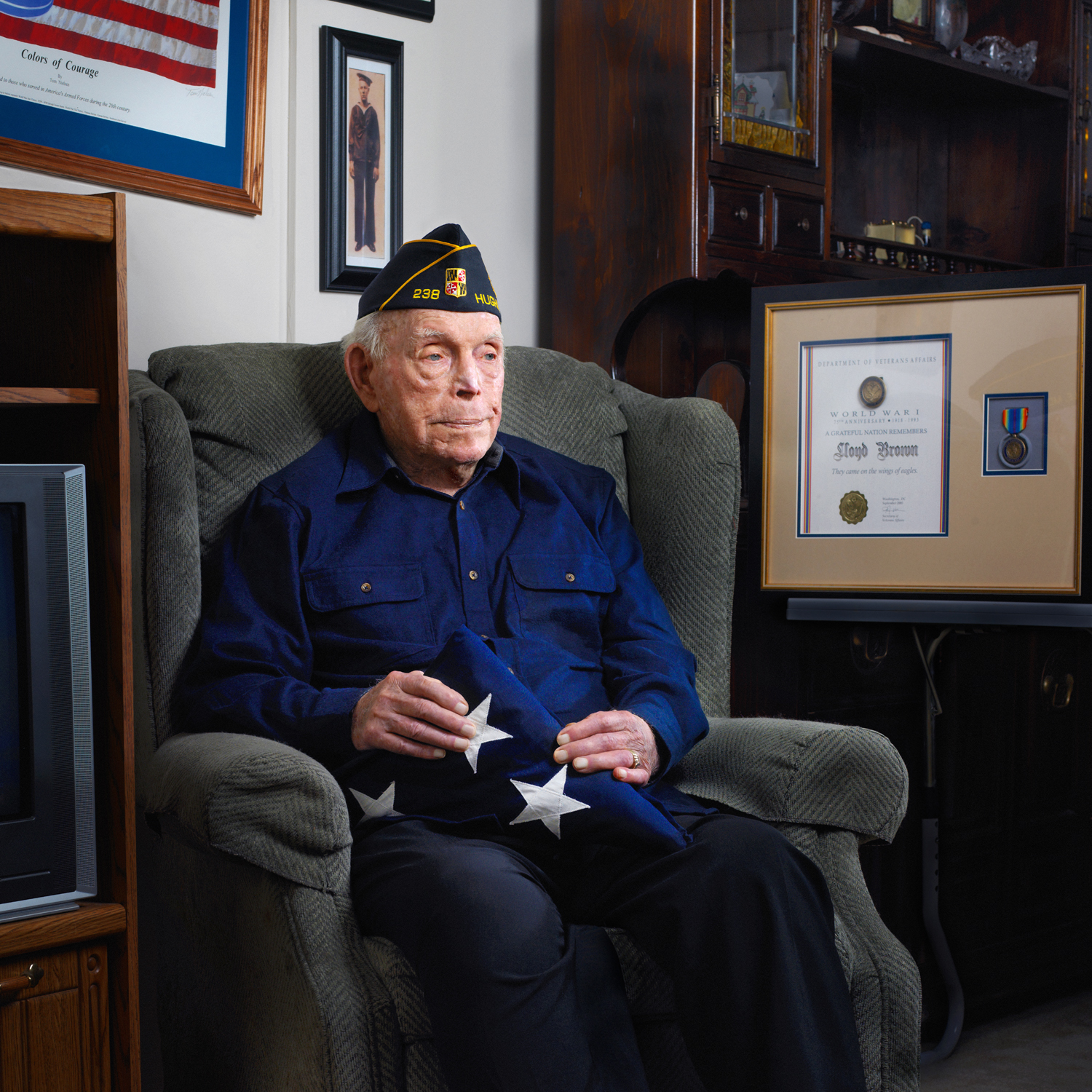
Portrait of Lloyd Brown by David J. DeJonge
Photograph by David J. DeJonge · From the Last Witnesses portrait record
Collection
The Pentagon Nine
Service nation
United States
Service
U.S. Navy · USS New Hampshire

The verified story

A life carried forward in the record.

Lloyd Brown was born in the small Missouri community of Lutie on October 7, 1901. Reports from Europe and the sinking of the Lusitania reached him as a teenager, and on April 2, 1918, he enlisted in the U.S. Navy at sixteen. He trained near Chicago before joining the battleship USS New Hampshire, which performed convoy escort and antisubmarine work in the North Atlantic during the war’s final months.

When DeJonge sought Brown decades later, Brown’s daughter offered a painfully apt direction: look for the mailbox with the name peeling off. The detail became part of the photographer’s larger question—how could one of the nation’s final living links to the Great War become so nearly invisible? Brown still carried vivid shipboard memories: wooden decks, hammocks suspended overhead, submarine watches, and the scale and polish of naval machinery. He recalled his ship bringing a captured German submarine to Philadelphia, although DeJonge noted that he could not locate an independent record confirming that episode.

Brown reenlisted in 1921. After studying music, he played cello in an admiral’s chamber ensemble aboard USS Seattle. Civilian life continued the pattern of public service: he joined the Washington fire department and later worked at National Airport. DeJonge’s portrait joins those chapters—the sixteen-year-old sailor, the musician at sea, the firefighter, and the elderly veteran behind a weathered name on a rural mailbox.
The completed record

What followed.

Brown died of a pulmonary embolism on March 29, 2007, at 105. Contemporary reporting and the Library of Congress identify him as the last known surviving U.S. Navy veteran of the First World War. He died before the Pentagon installation opened, so his principal post-session public recognition was posthumous: DeJonge’s portrait entered the nine-image permanent display unveiled on March 6, 2008. A later VA page gives April 2 as his death date, but that was the publication date of his contemporary obituary; March 29 is the supported date.

The archive · c. 2009–2010

David’s original exhibition story.

This text is preserved from the original traveling-exhibition record. It retains the language, grammar, and understanding of that moment. Dates, survivor distinctions, and later developments are corrected in the verified record above.

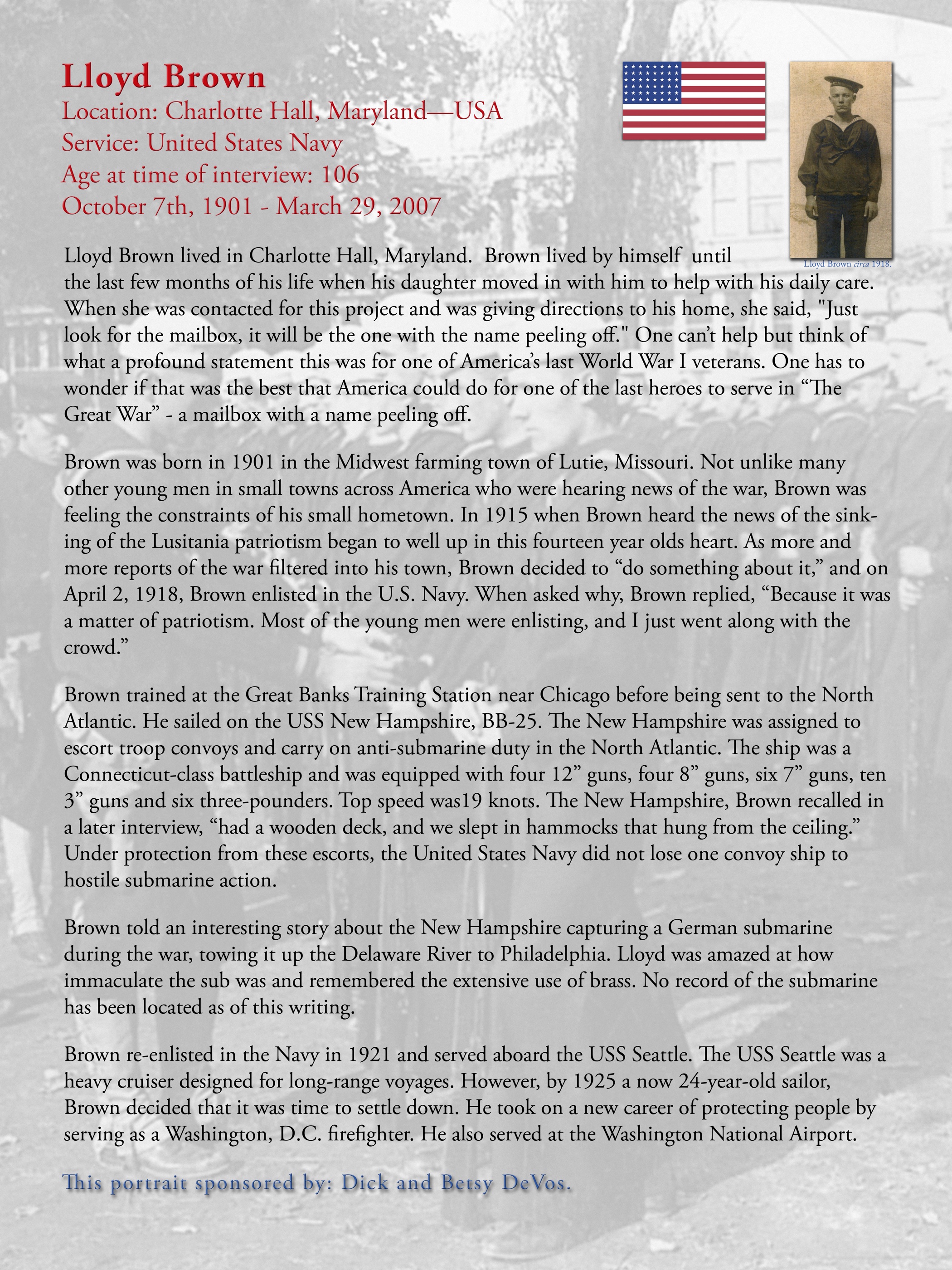
Original exhibition story panel for Lloyd Brown
Original exhibition panel by David J. DeJonge · Select to view at full web resolution
Read the complete original text

Lloyd Brown lived in Charlotte Hall, Maryland by himself up to a few months before his death when his daughter Nancy moved in with him to help with his daily life. When nancy was contacted for this project she said " Just look for the mailbox, it will be the one with the name peeling off." How profound of a statement for one of Americas last World War I veterans. Is this the best America could do for one of their last WWI veterans a mailbox with a name peeling off?

Brown was born in Lutie, Missouri in 1901. Lutie was a small farming town and at the turn of the century many small towns seemed to feel to constraining to young men hearing of the war overseas. In 1915 when the Lusitania was sunk, a young Brown heard the news and patriotism began to grow in this 14 year olds heart. As more and more reports of the war filtered in to this small Midwestern American town Brown decided to do something about it. On April 2, 1918, Brown enlisted into the U.S. Navy. Why? “Because it was a matter of patriotism. Most of the young men were enlisting, and I just went along with the crowd.”

Brown trained at the Great Banks Training Station near Chicago before being sent to the North Atlantic. He sailed on the USS New Hampshire, BB-25. The New Hampshire was assigned to troop convoy escort and anti-submarine duty in the North Atlantic. The ship was a Connecticut-class battleship and was equipped with four 12” guns, four 8” guns, six 7” guns, ten 3” guns and six 3 pounders and had a top speed of 19 knots. The New Hampshire, Brown recalled in a later interview “Had a wooden deck and we slept in hammocks that hung from the ceiling.” Under this groups protection the United States Navy did not lose one convoy ship to submarine action.

Brown told a story of their ship capturing a German sub and sailing up the Delaware River back to Philadelphia during World War One. Lloyd was amazed at how immaculate the sub was and with extensive use of brass. No record of the submarine has been located as of this writing.

He re-enlisted in 1921 and served aboard the USS Seattle. The USS Seattle was a heavy cruiser designed for long-range voyages. By 1925 however a now 24-year-old sailor it was time to settle down. Lloyd now was to take on a new career protecting people, a DC firefighter and served at the National Airport.

Documented record

Sources.