The Pentagon Nine · Pentagon 03

Frank Woodruff Buckles

🇺🇸United States

U.S. Army · ambulance and motorcycle driver

Frank Buckles was the last surviving U.S. veteran of the First World War and the last American veteran of that war to have served overseas.

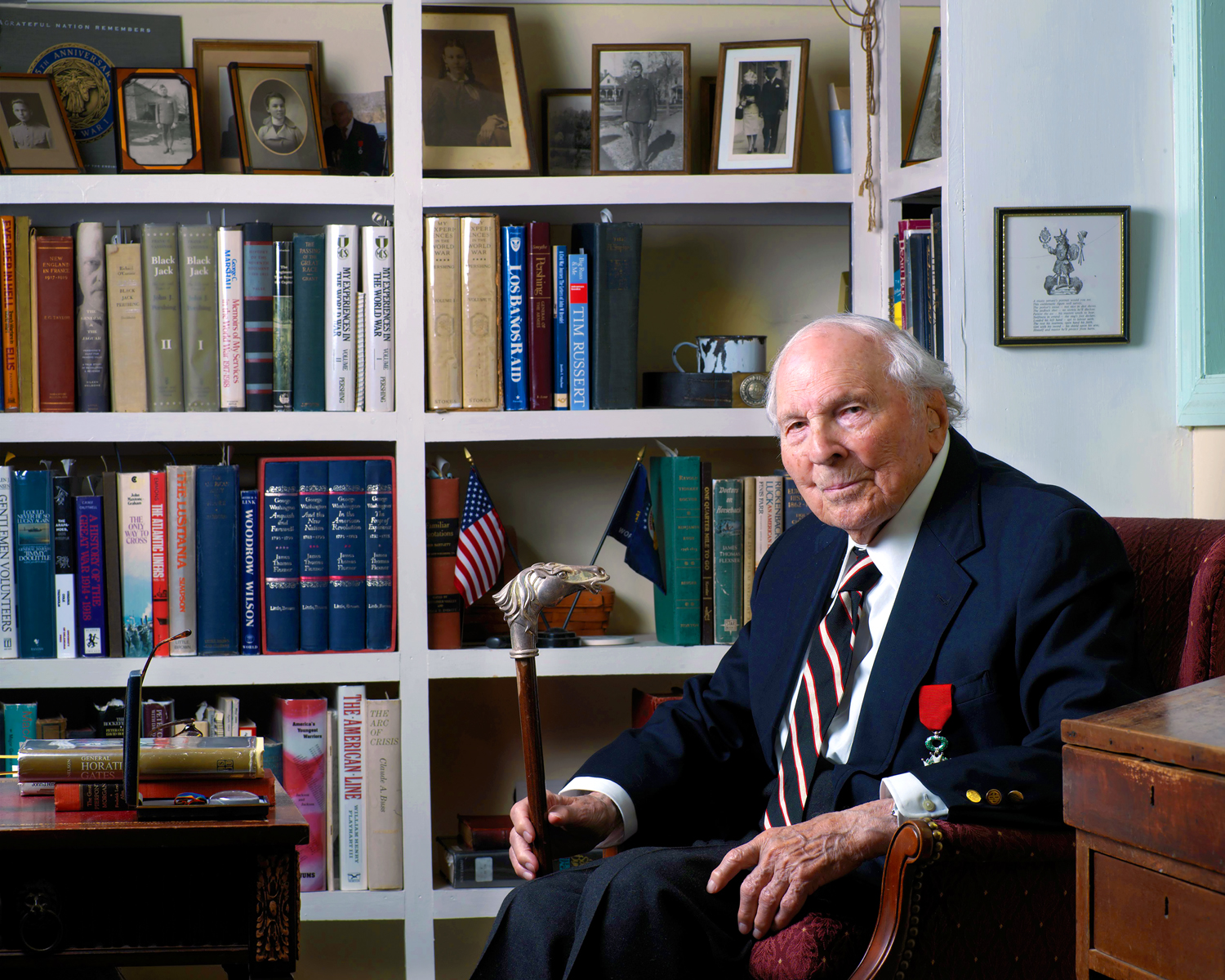
Portrait of Frank Woodruff Buckles by David J. DeJonge
Photograph by David J. DeJonge · From the Last Witnesses portrait record
Collection
The Pentagon Nine
Service nation
United States
Service
U.S. Army · ambulance and motorcycle driver

The verified story

A life carried forward in the record.

Frank Woodruff Buckles was born February 1, 1901, near Bethany, Missouri. At sixteen, while transporting family horses to Oklahoma, he decided to enlist without telling his parents. After several refusals, he persuaded an Army recruiter that he was old enough. Training at Fort Riley led to an Atlantic crossing aboard Carpathia, the ship that had rescued survivors of Titanic five years earlier.

Buckles served in England and France as a driver of cars, motorcycles, and ambulances. After the Armistice, he escorted German prisoners home and remained with the occupation forces before returning to the United States. The Army record is important here: Buckles served overseas, but he did not claim combat service. His life nevertheless crossed a second world war. Working in shipping in Manila when Japan invaded the Philippines, he was imprisoned as a civilian for more than three years and liberated in 1945.

DeJonge first approached Buckles as a witness. The relationship became a partnership. Buckles’s memory, composure, and insistence that the First World War generation deserved national recognition gave the portrait project a public mission beyond the frame. He was honored at the Pentagon and met President George W. Bush in 2008. In 2009, at 108, he spoke before a Senate subcommittee in support of a national memorial. The final American witness had become an advocate for millions whose voices were gone.
The completed record

What followed.

Buckles died on February 27, 2011, at 110. The proposal he supported—to rededicate the existing District of Columbia War Memorial on the National Mall as a combined national-and-District memorial—did not become law. The D.C. pavilion was restored in 2011 and remains a local memorial. Congress selected a different solution in 2014, redesignating Pershing Park on Pennsylvania Avenue as a World War I memorial. The National World War I Memorial opened there on April 16, 2021, and reached completion on September 13, 2024, with the unveiling and first illumination of A Soldier’s Journey.

  1. The District of Columbia War Memorial was restored and remained a local memorial to 499 District residents.
  2. Congress authorized a separate national memorial at Pershing Park—not the National Mall proposal Buckles and DeJonge had advanced.
  3. The National World War I Memorial opened to the public on April 16.
  4. A Soldier’s Journey was unveiled and illuminated, completing the memorial on September 13.
Continue to the memorial campaign →

The archive · c. 2009–2010

David’s original exhibition story.

This text is preserved from the original traveling-exhibition record. It retains the language, grammar, and understanding of that moment. Dates, survivor distinctions, and later developments are corrected in the verified record above.

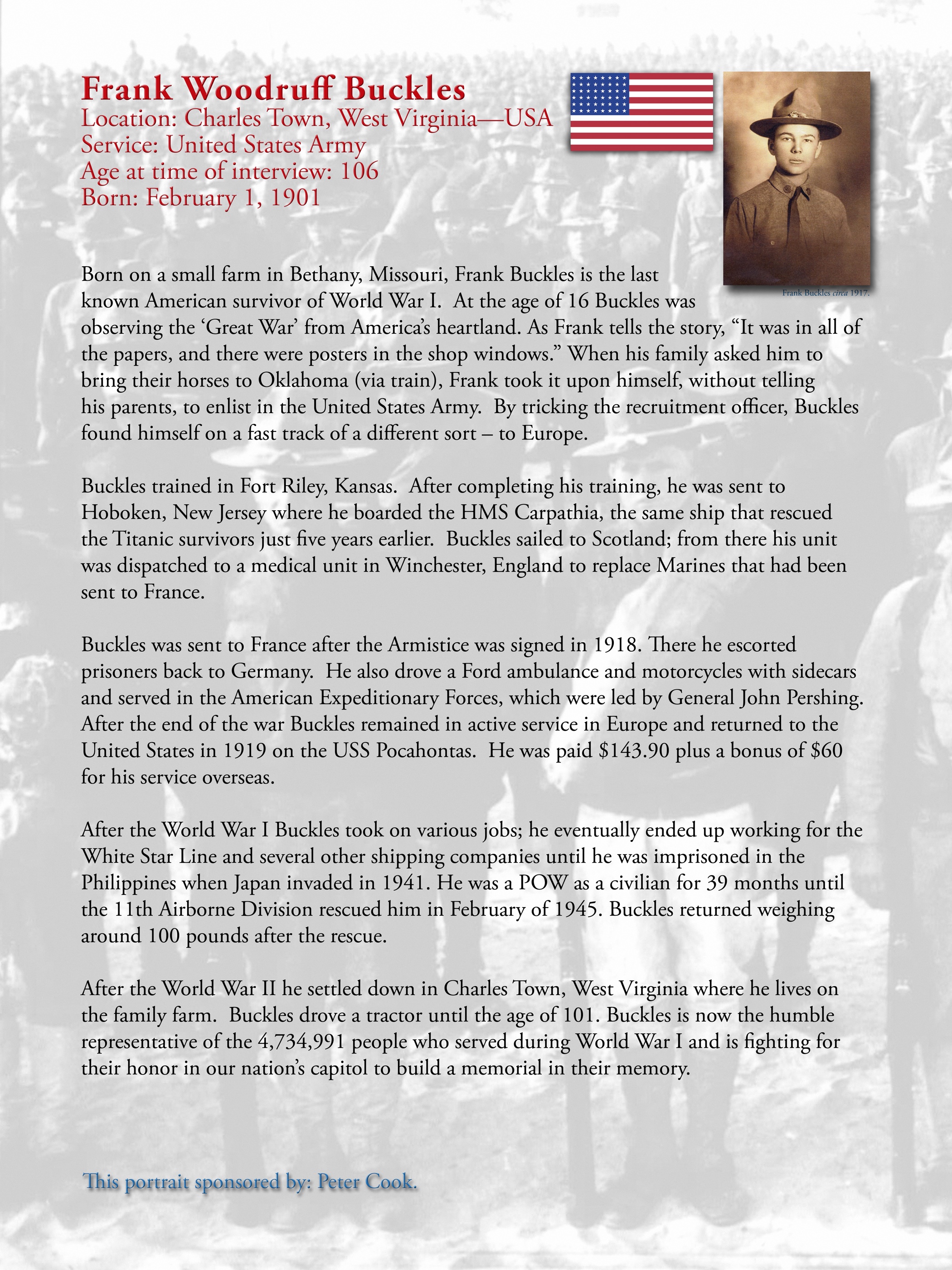
Original exhibition story panel for Frank Woodruff Buckles
Original exhibition panel by David J. DeJonge · Select to view at full web resolution
Read the complete original text

Frank Woodruff Buckles Charles Town, West Virginia—USA United States Army Age at time of interview: 106 Born February 1, 1901

Born in Bethany, Missouri on a small farm, Frank Buckles is the last known American Survivor of World War One. At the age of 16, Frank Buckles was observing the ‘Great War’ from America’s heartland. As Frank tells the story: “It was in all of the papers and there were posters in the shop windows.” When his family asked him to bring their horses to Oklahoma (via train), Frank took it upon himself to enlist in the United States Army without telling his parents. By tricking the recruitment officer Buckles found himself on a fast track of a different sort, to Europe.

Frank Buckles trained in Fort Riley, Kansas. He completed his training and was sent to depart from Hoboken, New Jersey. He rode to Scotland on the HMS Carpathia the same ship that rescued the Titanic survivors just 5 years earlier. The Carpathia docked in Scotland and his unit was then dispatched to a medical unit in Winchester, England to replace Marines that had been sent to France.

Buckles was sent to France after the Armistice was signed in 1918 and escorted prisoners back to Germany. Buckles drove a Ford ambulance and motorcycles with sidecars. Buckles served for the American Expeditionary Forces, which were led by General John Pershing. After the end of the war, Buckles remained in active service in Europe and returned to the United States in 1919. Buckles returned home to the United States on the USS Pocahontas and was paid $143.90 plus a bonus of $60 for his service overseas.

After the war Buckles took on various jobs but eventually ended up working for the White Star Line and several other shipping companies until imprisoned in the Philippines when Japan invaded in 1941. He was POW as a civilian for 39 months until being rescued by the 11th Airborne Division in February of 1945.

After the Second World War he moved to and settled down in Charles Town, West Virginia where he lives on the family farm. Buckles drove a tractor to the age of 101. Frank is now the humble representative of the 4,734,991 who served during WWI and is fighting for their honor in our Nation’s Capitol to build a Memorial in their memory.

Documented record

Sources.