The Pentagon Nine · Pentagon 01

John Henry Foster ‘Jack’ Babcock

🇨🇦Canada

Canadian Expeditionary Force · Young Soldiers Battalion

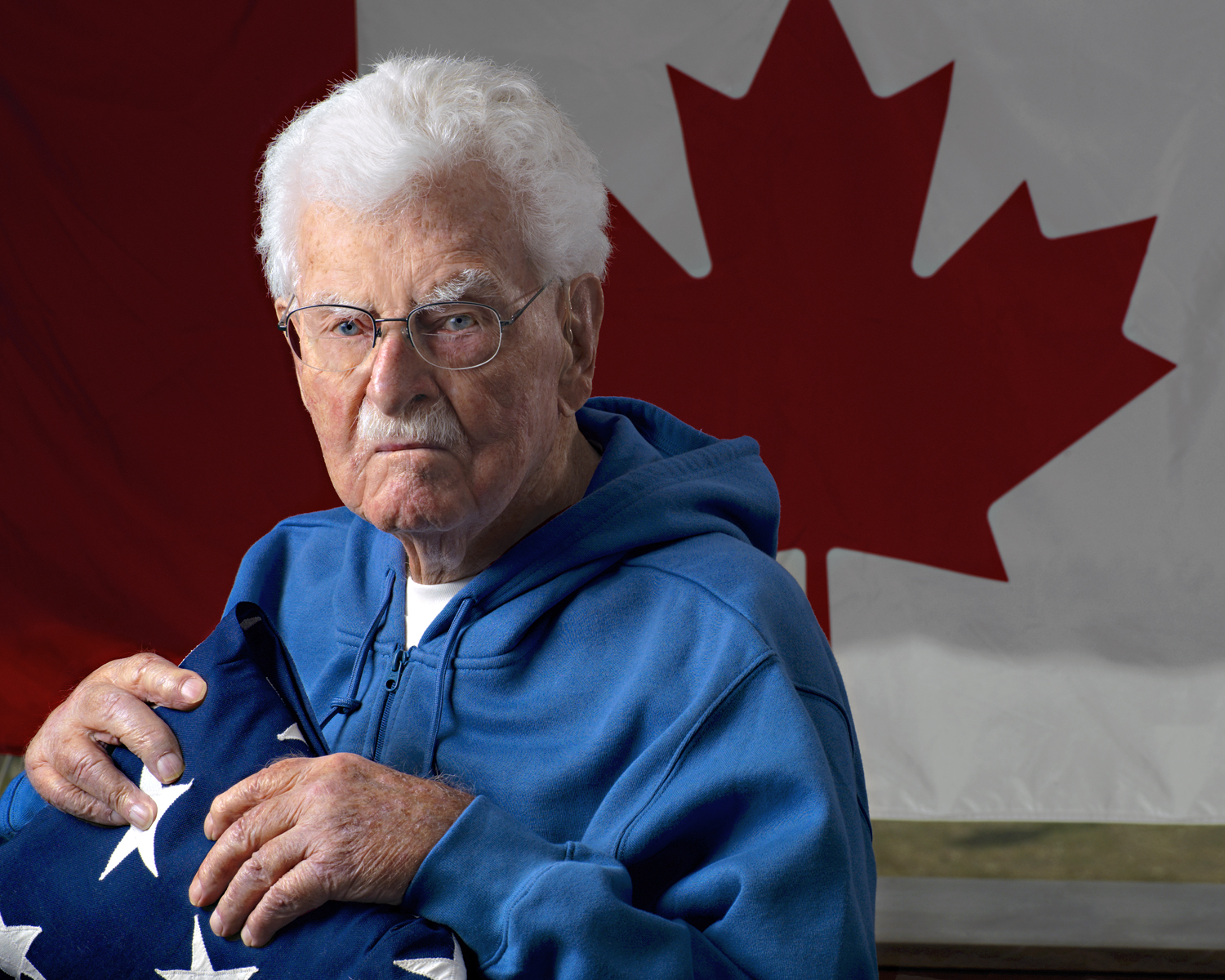
John Babcock was the last known surviving veteran to have served Canada in the First World War; he trained in England but was never sent to France and was not a combat veteran.

Portrait of John Babcock by David J. DeJonge
Photograph by David J. DeJonge · From the Last Witnesses portrait record
Collection
The Pentagon Nine
Service nation
Canada
Service
Canadian Expeditionary Force · Young Soldiers Battalion

The verified story

A life carried forward in the record.

John Henry Foster “Jack” Babcock entered the world on July 23, 1900, on his family’s farm near Holleford, Ontario. His childhood was defined by work and early loss. In the account he later gave David J. DeJonge, Babcock remembered tapping maple trees and helping on the farm, then seeing his father brought home after a fatal tree-felling accident. Independence arrived long before adulthood.

At fifteen, Babcock enlisted in the Canadian Expeditionary Force and was assigned to a Young Soldiers Battalion. He reached England, where the underage recruits marched and trained, but he was never sent to France and did not see combat. His memories nevertheless carried the war’s psychological cost: vulnerable young servicemen, the tension of waiting, and the wreckage of downed airships he saw in England.

Babcock later settled in the United States and became an American citizen in 1946. More than six decades afterward, he asked to recover the citizenship of the country in which he had been born. Canada welcomed him back in 2008 and also presented him with the Minister of Veterans Affairs Commendation. DeJonge’s portrait therefore records more than longevity. It holds a life stretched between two countries and a teenage act of service that, although it never reached the battlefield, became Canada’s final living connection to its First World War forces.
The completed record

What followed.

Babcock died on February 18, 2010, at 109. The Government of Canada recognized him as the last known surviving veteran to have served Canada in the First World War. His 2008 return to Canadian citizenship and Minister of Veterans Affairs Commendation became important late-life recognitions; after his death, Canada marked the end of the country’s living First World War generation with a national commemorative observance. His portrait remains one of the two Pentagon Nine images whose subject was alive when the installation opened in 2008.

The archive · c. 2009–2010

David’s original exhibition story.

This text is preserved from the original traveling-exhibition record. It retains the language, grammar, and understanding of that moment. Dates, survivor distinctions, and later developments are corrected in the verified record above.

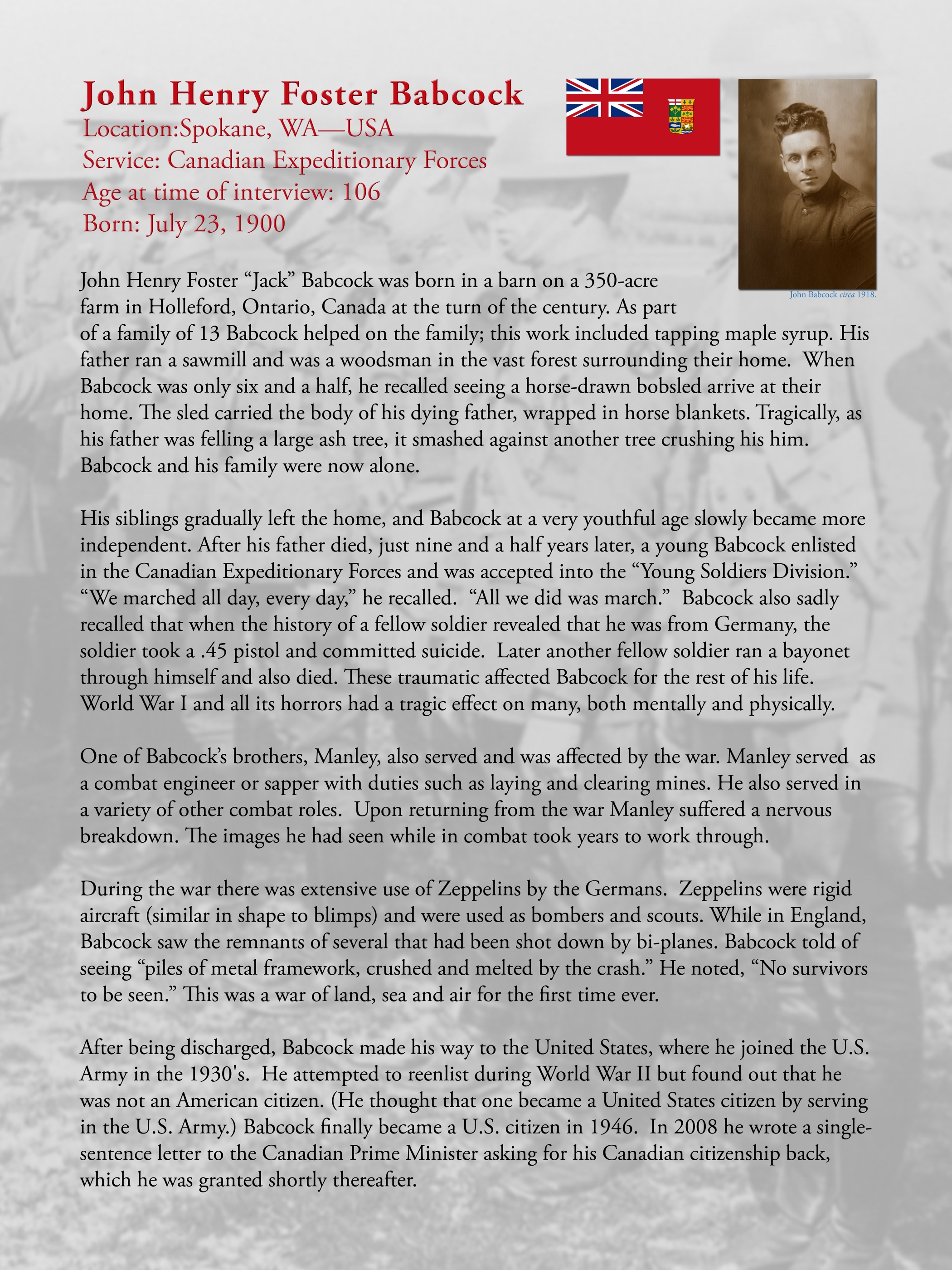
Original exhibition story panel for John Henry Foster Babcock
Original exhibition panel by David J. DeJonge · Select to view at full web resolution
Read the complete original text

John ‘Jack’ Henry Foster Babcock was born in a barn on the 350-acre farm in Holleford, Canada, in Ontario. Babcock helped on the farm and tapped maple syrup as a child. Born into a family of 13, his father ran a sawmill and was a woodsman in the vast turn of the century forest surrounding their home. When Babcock was only six and half he recalled seeing a horse drawn bobsled arrive at the home. Carried on that sled was his father. Wrapped in horse blankets his father lay dieing. While sawing a tree a catastrophic accident occurred, when felling a large ash tree it smashed against another tree crushing his father. Babcock and his family were now alone.

His brothers and family gradually left and Babcock would slowly become more independent at a very youthful age. Just nine and a half years later a young Jack Babcock enlisted in the Canadian Expeditionary Forces and was accepted into the ‘Young Soldiers Division’. “We marched all day he recalled, “Marching every day all day. All we did was march”. When a fellow soldiers history was revealed as being from Germany, the soldier took a .45 and committed suicide. Later another fellow soldier ran a bayonet through himself and also died. This war and the horrors of it were tragic both mentally and physically. This traumatically affected Babcock for the rest of his life.

One of John’s brothers Manley also served and was affected by the war. Manley served with the engineers as a sapper with duties of laying mines and a variety of tasks under combat. The images he had seen while in combat took years to work through. Upon returning from the war his brother suffered a nervous breakdown.

While in England Babcock would go and witness the remnants dirigibles that were shot down by the bi-planes. There were piles of metal as described by Babcock. The dirigibles framework melted and crushed by the crash. No survivors to be seen. This was a war of air, land and sea for the first time ever.

After being discharged he made his way to the United States where he joined the US Army in the 1930's. He attempted to re enlist during WWII. He then found out that he was not an American citizen (He thought that you became a citizen while serving in the Army de facto) and became a citizen in 1946. In 2008 he wrote a one-sentence letter to the Canadian Prime Minister asking for his Canadian citizenship back, which he was granted shortly thereafter.

Babcock is the last Canadian citizen who served during World War One.

Documented record

Sources.