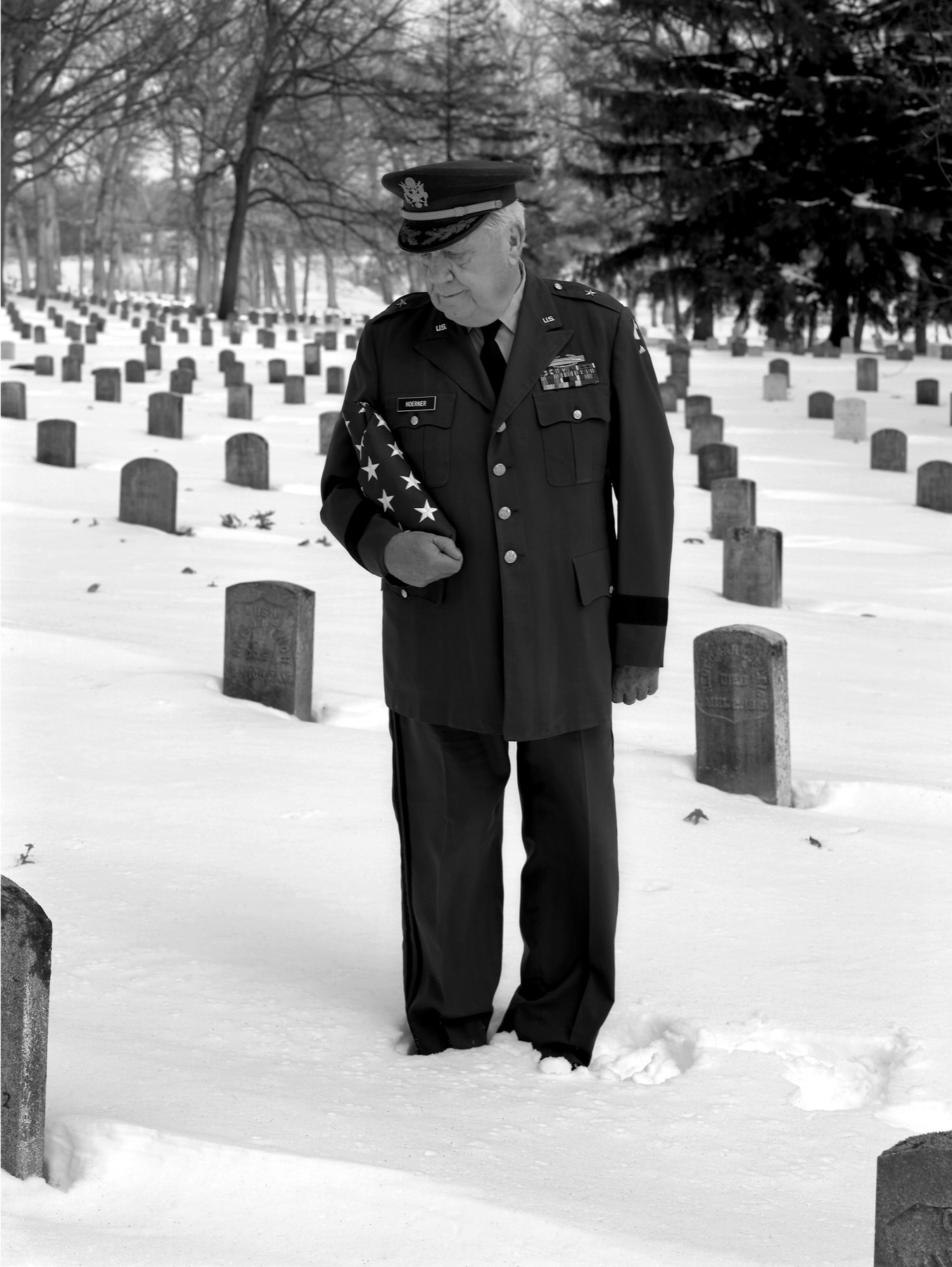
A gentle bear of a man, Jim Hoerner of Ada has the commanding presence and raspy growl of a great storyteller. The words seem to come from somewhere deep inside his big, six-foot-two-inch frame. His face flushes with emotion, and his brown eyes fill with memories as he recalls the way it was in World War II, during the June 1944 Invasion of Normandy.
Just out of Officers’ Candidate School, Hoerner was 23, inexperienced and untrained, when he became a company commander. Landing at Omaha Beach on “D-Day plus one,” he remembers “when we were given our orders about the attack, our position, and the boys in the platoon all gathered around. The only thing I could think of – I had a little prayer book they had issued – the only thing . . . in there that seemed to be worth a darn to me was the 23rd Psalm, which I then recited to my people. It always did affect me,” he says as his big voice fades to a hush, “It was kind of the Valley of death.”
Indeed, 9,966 people are buried in the Omaha Beach cemetery, and of the seven officers with whom Hoerner landed, only he came out alive. From this rough beginning, Hoerner’s company pushed on with Pattons’ Third Army across France, Belgium, Luxembourg, and southern Germany, then to Czechoslovakia.
“We say 281 days of combat,” Hoerner says. “We fought in many hard battles.”
One of the worst occurred in the Siegfreid Line, near the Saar River, where he took 135 men into the trenches, holding the positions until he came out, five or six days later, with only eighteen left. “We propped up the dead,” he says quietly, “to make the Germans think we had more men.”
For that action Hoerner received the British Military Cross and the French Croix de Guerre. For years they have been hidden with the rest of his many medals in a bureau drawer. Even now he dismisses the three Purple Hearts, which indicate he was wounded three times. About his Bronze Star with Oak Leaf Cluster and citation for valor he says simply, “Oh, somebody thought I did a good job.” The Silver Star with two Oak Leaf Clusters means only, “somebody thought you did something extraordinary.”
Hoerner has three.
The single award he will admit to being pleased with is his induction, several years ago, into the Infantry Hall of Fame, because “It’s recognition of your peers. Somebody in the Infantry saying you’re O.K.”
After the Armistice in may of 1945, Hoerner stayed with the occupying troops in southern Germany, then was on reserve status until called back briefly for the Berlin Airlift in 1961. He entered engineering school at the University of Michigan, but dropped out and bought a business in Grand Rapids when he and his late wife, Mary, began their family of two boys and three girls.
Resuming a normal, civilian life was tough. “During the war,” Hoerner reflects, “a lot of people had kind of bad experiences. They were far from human beings. They were animals, really, because you learn to live with the elements . . . to survive.”
A devout Catholic, Hoerner attends early mass every day, “for Thanksgiving . . . for having been spared.” In 1978 he retired from the reserves with the rank of Brigadier General; and on the 50th anniversary of D-Day, Hoerner returned to France with a deeper understanding of what all those days of combat meant.
“Combat is a struggle for your soul,” Hoerner believes. “If you can meet that, and if you are successful in defeating despair, then you become whole. You know then that there is no hurt, not anything that can happen anymore, that hasn’t already happened, that you cannot survive.”