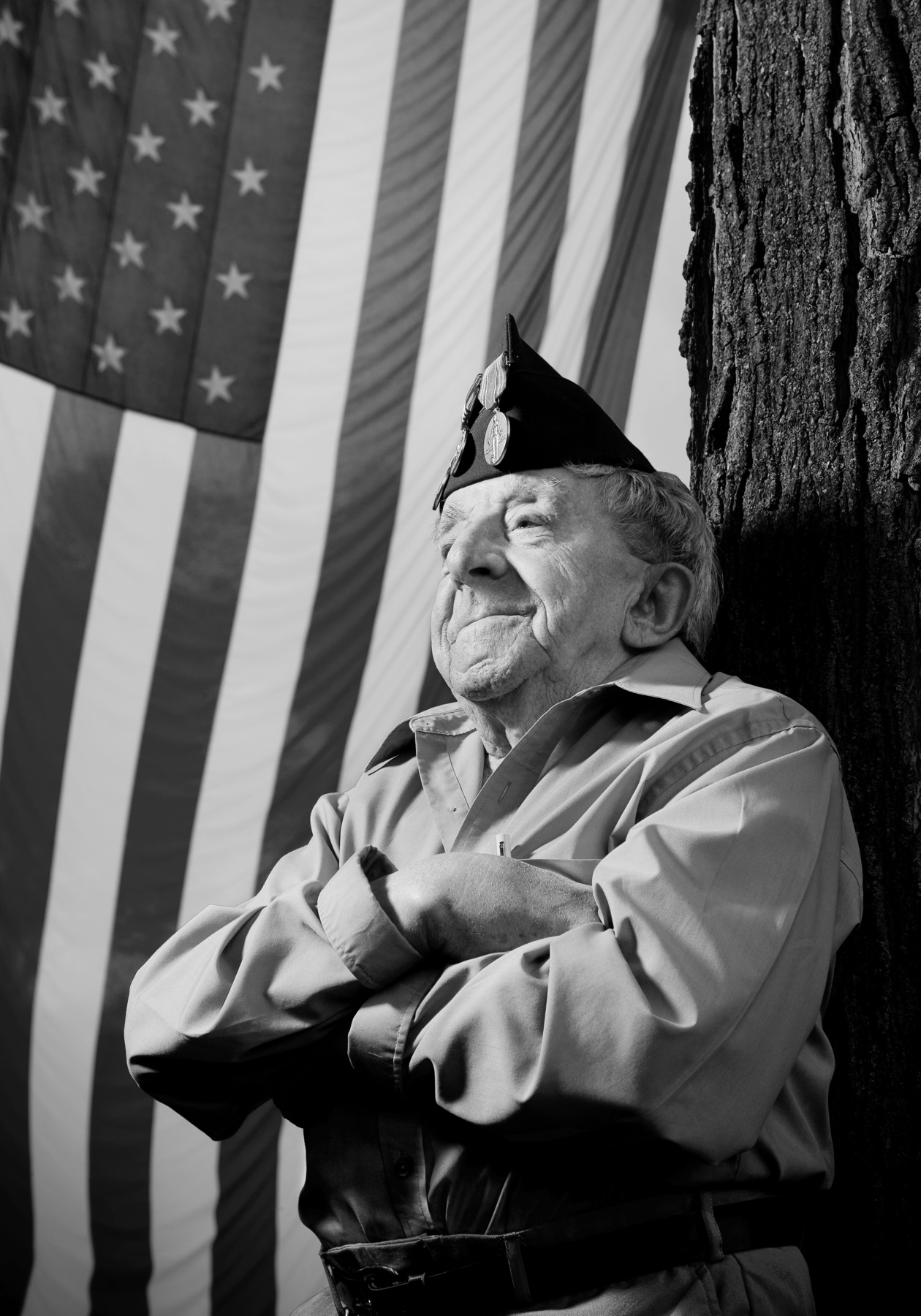
Faces of Five Wars · Original story
Louie Dellapella
U.S. Army · World War II
Read the original story ↓There is a special kind of love that few people are capable of giving. Most of us, while centered on ourselves, are willing to sacrifice for those to whom we are related, or those in whom we are invested. Behavioral scientists call this “kin altruism,” a part of the instinctual preservation of our gene pool. To pay serious attention to the needs of those outside our intimate group is unusual. It is the kind of love envisioned by saints and spiritual masters. And it is the kind of love poured out by Luegie “Louie” Dellapella.
A first generation Italian-American, Dellapella, age 86, decided about three years ago to move into the Grand Rapids Home for Veterans. “I found out I could do some good for some people,” explains Dellapella, who runs a weekly evening worship service at the Home. But “doing good” has been his modus operandi since childhood. At age 11, he lost his father, so Dellapella and his siblings were forced to go out with “a rake, a shovel, or a lawnmower” and do whatever they could to raise money. The difficulty of those hard times is tempered by memories of his mother, “a beautiful woman,” who nurtured both his love of music and a generous compassion for others.
It is this empathy, together with his ability to listen well, that have shaped Dellapella’s life of service. As a processor during World War II, he interviewed and mustered in soldiers for the Army. He was in the DEML, the Detached Enlisted Men’s List, stationed at Fort Ascot near Brisbane, Australia. “One night we were awakened at 2 AM to get ready to process about 100 men that turned out to be Indians,” he remembers. “I asked one his name; he said, ‘Good Night.’ I said, ‘Not yet, we have a lot to do.’ He said, ‘That’s my name!’ After some more, one was ‘Heavy Runner.’ I made no comment,” Dellapella smiles. “These were the ‘Code Talkers’.”
By using their native languages as secret code, the famous Commanche and Navajo “Code Talkers” helped outwit the Germans and win the war. But as memorable as meeting them was, what Dellapella could never forget about the war was something quite different. “Two days after Pearl Harbor the Japs did another surprise bombing, on Manila,” Dellapella relates. “They hit a lot of civilians, mostly women and children.” Once Dellapella saw these wounded children, “without a hand, or a leg . . . parts missing,” he never got over it. And these haunting images, along with the memories of his own childhood struggles, moved him to action.
“Thinking of these children I told my wife, ‘I’ve got to do something’,” Della-pella says passionately. “It made me nervous.” So he started his post-war life in Dowagiac, working in the grocery business and devoting his free time to children. Initially, he volunteered with 5th and 6th-graders in Sunday School at First Christian Church, then worked with the Junior and Senior High Youth Groups. He also supervised 12 units of Boy Scouts and started a Big Brothers’ mentoring program. “What it all boils down to is take care of the kids,” he affirms. “Kids are number one!”
Ironically, this man who adored kids never had any biological children of his own. But, in another example of his moving beyond “kin altruism,” he became a devoted stepfather to the five children of his second wife. Now he shepherds a flock of soldiers at his worship services. “At first,” he chuckles, “there were only two people in attendance, me and Jesus Christ.” But in the last two years his ministry has grown as he has prayed and discussed the Bible with his friends. “I don’t know how much more time I have,” he reflects, grateful to have had the chance to serve, “but I’ll do what I can while I’m here.”