Faces of Five Wars · Original story
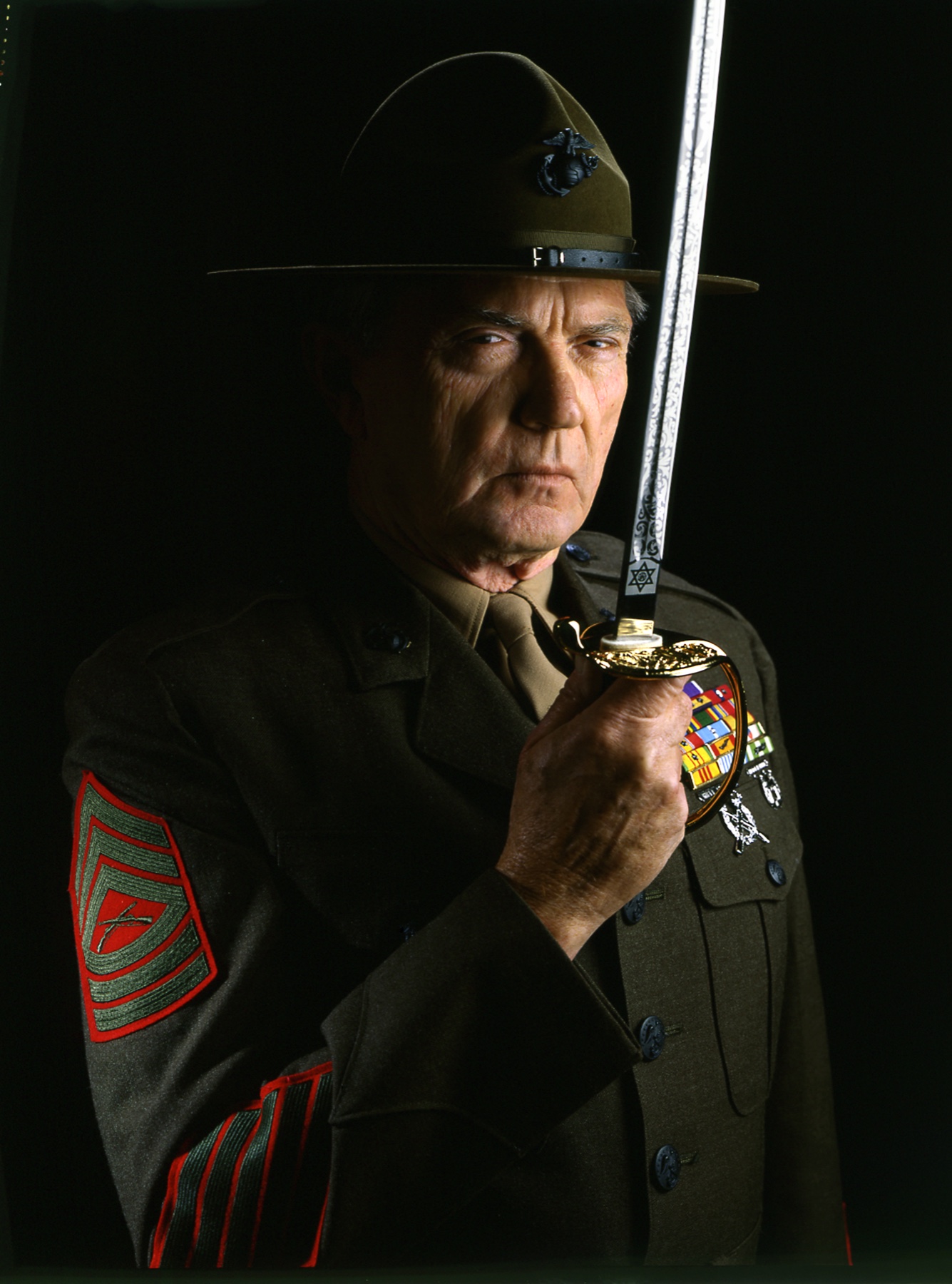
Gerald Krygier
U.S. Marine Corps · Korea and Vietnam
Read the original story ↓“I was in the war no one remembers and the one no one wants to remember,” says Gerald Krygier of southeast Grand Rapids. A master sergeant in the U.S. Marine Corps, Krygier served in both Korea and Viet Nam. Originally enlisting as part of the “Grand Rapids Platoon,” he had been a Marine for four years before being sent to Korea in 1950.
“We sailed through a typhoon on the way to battle,” Krygier recalls, “then we made the Inchon landing, and from Inchon we fought our way clear up to Seoul.” His first battle experience was at Yongdungpo, a suburb of Seoul across the River Han. Entrenched at the top of a dirt dike overlooking the river, his company was awaiting reinforcements when they were attacked by five North Korean tanks.
“Every time they fired, it felt like you were just being lifted right out of that foxhole,” Krygier reports. Luckily the tanks’ shells smashed into the dike before exploding, and little harm was done. The North Koreans then decided on a “Banzai-style” ground attack. Exhorted by their commander, bugles blaring and flares exploding, they came, “screaming and hollering to get you to run.” But the stalwart Marines stayed and eventually took back the South Korean capitol from the invading communists.
Until Desert Storm, Krygier observes, the initial Korean engagements were “the last type of warfare that we had where you had an enemy line ‘there,’ and we were ‘here.’” As the Americans moved over the North Korean border, the enemy was in the hills using guerrilla tactics to attack sporadically and unexpectedly, a method Krygier witnessed first-and from 1962 to 1963, when he was a weapons instructor in a school south of Saigon. At that time nobody seemed to be in charge in the South Vietnamese government, Krygier remembers. Decisions were left to the head of the local province, who responded to Viet Cong guerrilla attacks by saying, “we don’t fight today, maybe tomorrow.”
Back in the United States, Krygier, who had already switched from infantry to aviation, received advanced training and returned to South Viet Nam as operations chief of the 1st Marine Air Wing in DaNang. Stationed in the rear, in a supposedly “safe area,” he was wounded during a rocket attack on July 15, 1967.
“It felt like somebody got me by the seat of the pants . . . picked me up and threw me about 15 feet,” he relates. After the explosion it was deathly quiet and very dark-the fluorescent lights had been hit, sending little pieces of glass flying, like shrapnel. Krygier had been hit by these and by bigger pieces of metal. “I felt wet all over,” he says, describing the eerie metal. “I felt wet all over,” he says, describing the eerie scene. “And when they put on these lanterns, everybody’s standing around and there’s blood pouring off everybody. It looked . . . real gory.”
Through Krygier was awarded the Purple Heart for the incident, by the next day he was back on the job. For reasons understandable, perhaps, only to other soldiers, he asked for air combat assignment and spent the TET offensive as a gunner aboard a Huey helicopter, escorting the med-evac choppers into and out of “hot spots.” After earning two Air Medals and the Combat Aircrewman Insignia, Krygier retired in May of 1968.
But “Once a Marine, always a Marine,” is true Krygier laughs, pointing at his heart. “It says with you, in here.” Being a Marine, after all, is the only thing he ever wanted, since the age of 11. “I had a ‘love affair’ with the Corps,” he admits. “I wanted it so bad I didn’t care what it cost, how much discipline I had to take.” Though it was often difficult, Krygier believes: “I got stronger the more I tested, each skirmish, each action, each death.”