Faces of Five Wars · Original story
Muriel Land
U.S. Navy · Vietnam and Desert Storm
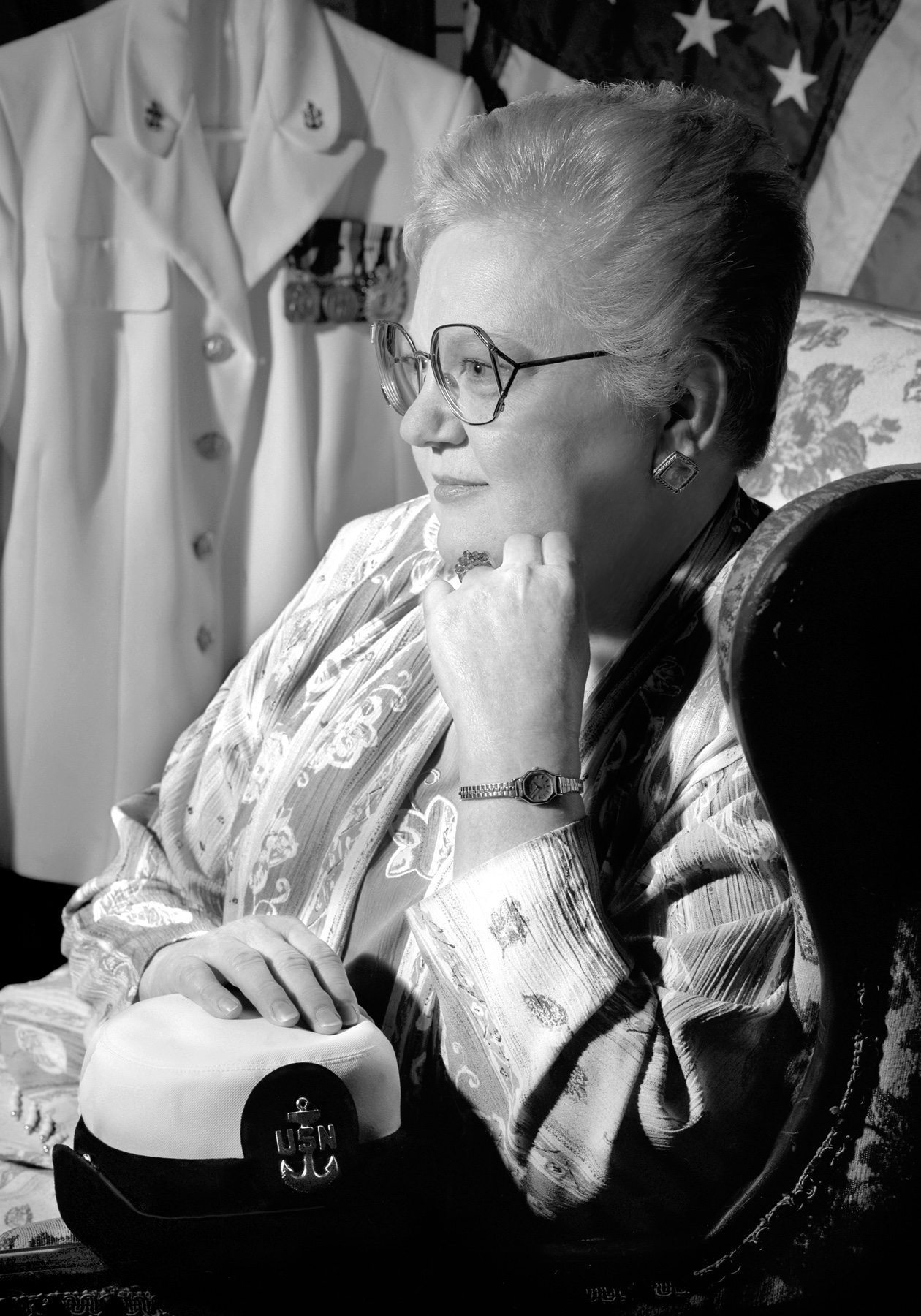
Read the original story ↓At Muriel Land’s retirement party in 1993, her Naval colleagues gave her a sign that read, “You’ve come a long way, baby.” And both Land and the Navy had. From her enlistment in 1969, when some male officers voiced crude opinions about where women should be, to her final post as Lead Chief Petty Officer, Land had seen changes she describes as “awesome.” Those were personal as well as political struggles, however, and Land doesn’t talk about them much. What she dwells on are the good people she met, the battles in which they took part, and the faith that sustained her.
Never close to actual combat, Land handled the administrative end for those who were, especially during Operation Desert Shield/Desert Storm. She also had an unusual vantage point for Vietnam. On the way to her first duty station at Barbers Point, Hawaii, the 25-year-old Land was on a plane “full of men going to Vietnam.” The mood was somber; there was none of the noise of families and babies crying normal for military transport. “Hawaii was just a stopover” for these particular passengers. “I’ve many times wondered,” she says softly, “how many of them came back.”
On the far end of the island, involved in air target testing and everyday search and rescue, Land did not have much contact with the war. She does remember occasionally seeing those who came from Vietnam for R & R (rest and relaxation). “They just wanted to come to Hawaii and have a good time,” she says, “to forget.” Land was closer to the action during Desert Storm. As the Chief Yeoman of Patrol Squadron Four (VP 4, the “Skinny Dragons”), she was stationed on the island of Diego Garcia, in the middle of British Indian Ocean Territory. About five miles wide and 30 miles long, the island is “way below the tip of India,” about two degrees above the equator. Lushly tropical, it was a staging area for the squad’s P-3 Orion aircraft, whose detachment site was 1500 miles, or eight hours, north at Masirah, Oman.
Originally used to track subs during the Cold War, the planes’ Desert Storm duty was patrolling the Gulf and locating Iraqi vessels. When the crews first flew off, everyone was scared, Land reports. Boxes of body bags had been ordered, because “They didn’t know what to expect, whether they were going to get shot at or not.” Only once did they receive fire, and ultimately, the squad was responsible for helping to destroy 30 Iraqi vessels.
Land’s most significant memory during this time was on January 16, 1991, the night before the air was started. “We were in the barracks, and all of the sudden I heard this rumbling. I went out on the balcony-all the B-52’s on that island (about 80) took off, and they were all flying to Iraq.” Watching the “monstrous…mighty” planes fly “straight up,” with “all the exhaust” trailing behind like some dragon’s tail, Land thrilled to the “awesome sight.” If she had been Sadam Hussein, seeing them coming, “I’d be waving that white flag.”
Another significant part of the war was the public response to Desert Storm. There was a huge store, stocked with donations, in Masirah, reports Land, and military personnel could go in and get almost anything they wanted, free. And there were boxes and boxes of cookies, sent by bakeries and loving hands back home, all of the addressed to “Any Service Member.” In her scrapbook of memories, Land has a letter from and elementary student. “I like to say the Pledge of Allegiance,” it reads. “We tied yellow ribbons for your safe return.”
When the Desert Storm veterans came home, Land recalls, it was indeed a “yellow ribbon summer.” Welcoming ribbons and banners were tied or hung every place imaginable. At places like the San Diego Zoo and Sea World, “If it wasn’t free to the military, it was half-price. All Land could think of then was how the soldiers from Vietnam “got nothing.” She is not quite sure how it happened, but she believes that in some way the Vietnam veterans were included in the Desert Storm celebration too. “It almost made it better in a way,” Land speculates. “I think it was a long time since the country had pulled together, since World War II, really. And here, for some reason, they all pulled together again.”