Faces of Five Wars · Original story
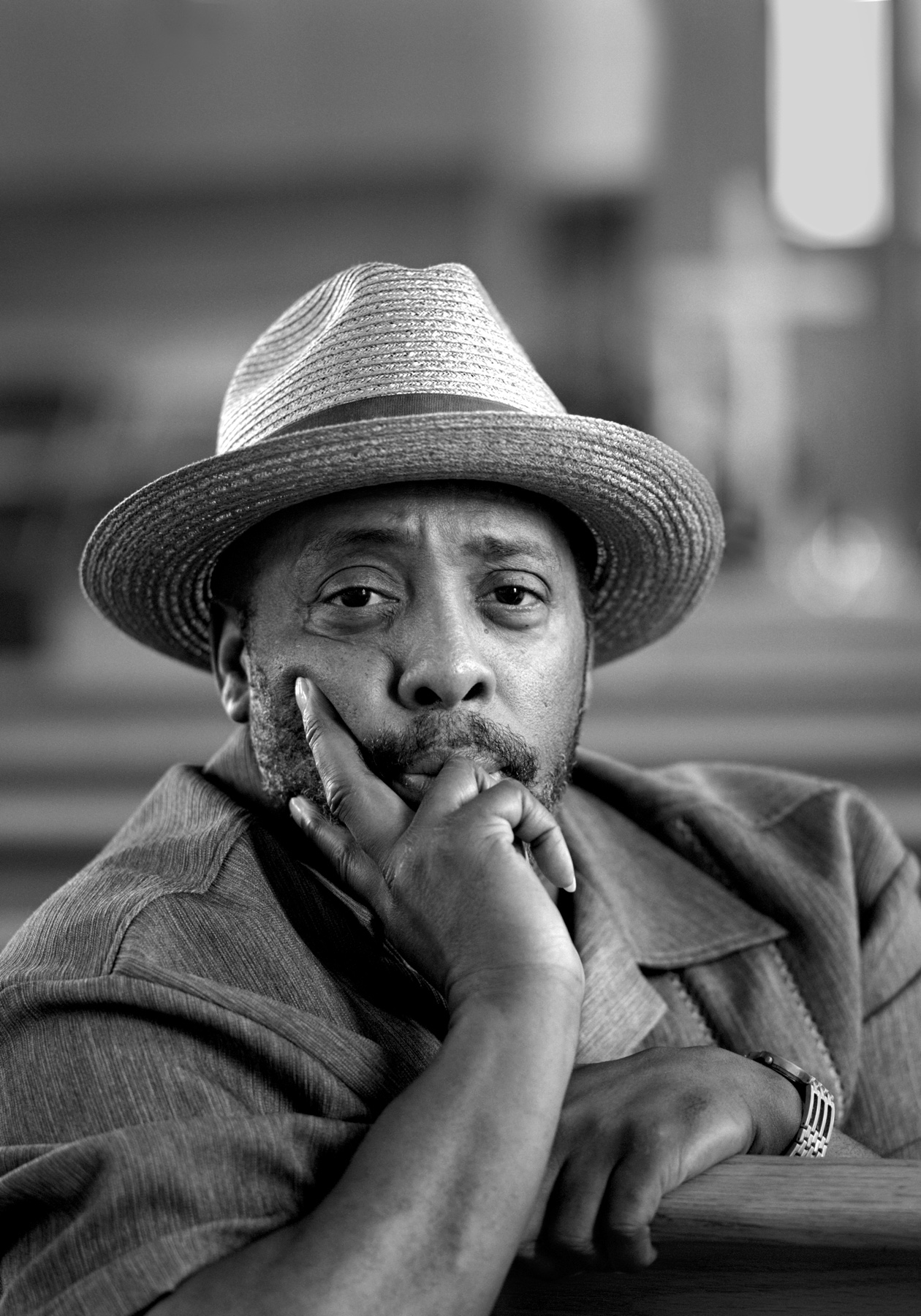
Clyde E. Sims, Jr.
U.S. Army · Vietnam War
Read the original story ↓Few of us have the courage to look into our souls and admit what is there. Clyde Sims, Jr., calls it “coming to the end of ourselves.” Eleven years ago, Sims stood on his apartment balcony, addicted to drugs and alcohol, convicted of murder, and said: “Oh God, I’d rather die than live like this.”
It was then, Sims believes, that “I came to the end of myself, and I think that’s when I really asked God to come into my life.” A volunteer drug counselor and an at-home parent to his two youngest sons, Sims is an associate pastor at True Light Baptist Church in Grand Rapids. His experiences have made him uniquely qualified to help those in physical, mental, or emotional pain. “I’m just thankful god gave me the ability and the nerve to face up,” he says humbly, “because our deepest secrets keep us sick.”
When Sims examines his life, it falls dramatically into two parts: before Vietnam and after. The product of a loving, “fairy tale upbringing,” he was a gifted high school athlete who won citizenship awards until he graduated in 1966. Then came Vietnam; by September 1968, on a jungle hillside somewhere near the border of North Vietnam, Sims’ right leg was shattered by a “dirty bullet.” After convalescing, he came home to a life on pain and medication, legal and illegal. “I was like a wounded animal,” Sims admits. “Pain can make you do crazy things.” Suffering a nervous breakdown in 1971, he was in and out of mental institutions until 1976, when he was sent to prison for murder, the first person in Michigan to be sentenced “guilty but mentally ill.”
While in prison, Sims broke his bad leg, and doctors discovered the old war would had caused a rare and painful bone disease. Sims’ leg was amputated in 1983. In the years since, he has struggled to come to terms with what he did, and what was done to him. As he tells his story, there is a deep awareness of the ambiguity inherent in life-shaping events, the good and evil embedded in each of us.
During the war, Sims and another man, Steve Helms, were in charge of their unit’s heavy machine gun. The other man, Sims smiles gently, was a “white guy from Kansas,” and “we didn’t hit it off right away, because he didn’t want to carry the thing, and I didn’t’.” But after they had been through battle, spending long nights alternating watch, one man on guard while the other slept with his head in his buddy’s lap, they developed quite a bond. One day, when Sims and Helms were out on a mission, searching for a place to set up the gun, they ventured too far from their unit and were ambushed. In the confusion of fear and gunfire that followed, Sims is not sure whether or not he clipped on Helms’ ammunition.
“Sometimes I say, ‘You did, Clyde, you did,’ and then sometimes I say, ‘you didn’t,’” Sims agonizes. Both Sims and Helms were hit. As they lay, slumped on the hillside five or six feet away from each other, Sims realized their cries for help only drew enemy fire. He quit shouting, but Helms did not and was hit ten or twelve more times. Meanwhile, Sims’ comrades were calling out assurances, waiting for the right moment to rescue him. “They didn’t leave us,” Sims says, greatly moved, his rich voice rising and falling like gentle rain. “And when they finally got me back to the helicopter, all the guys walked up and kissed me. They said, ‘Go home, baby,’… I don’t even know their names or where they’re from.” The personal cost of war, Sims concludes, “is enormous . . . I wanted to be a soldier all my life. I’m a soldier for the Lord now. But I take pride in the fact that I answered the call.”