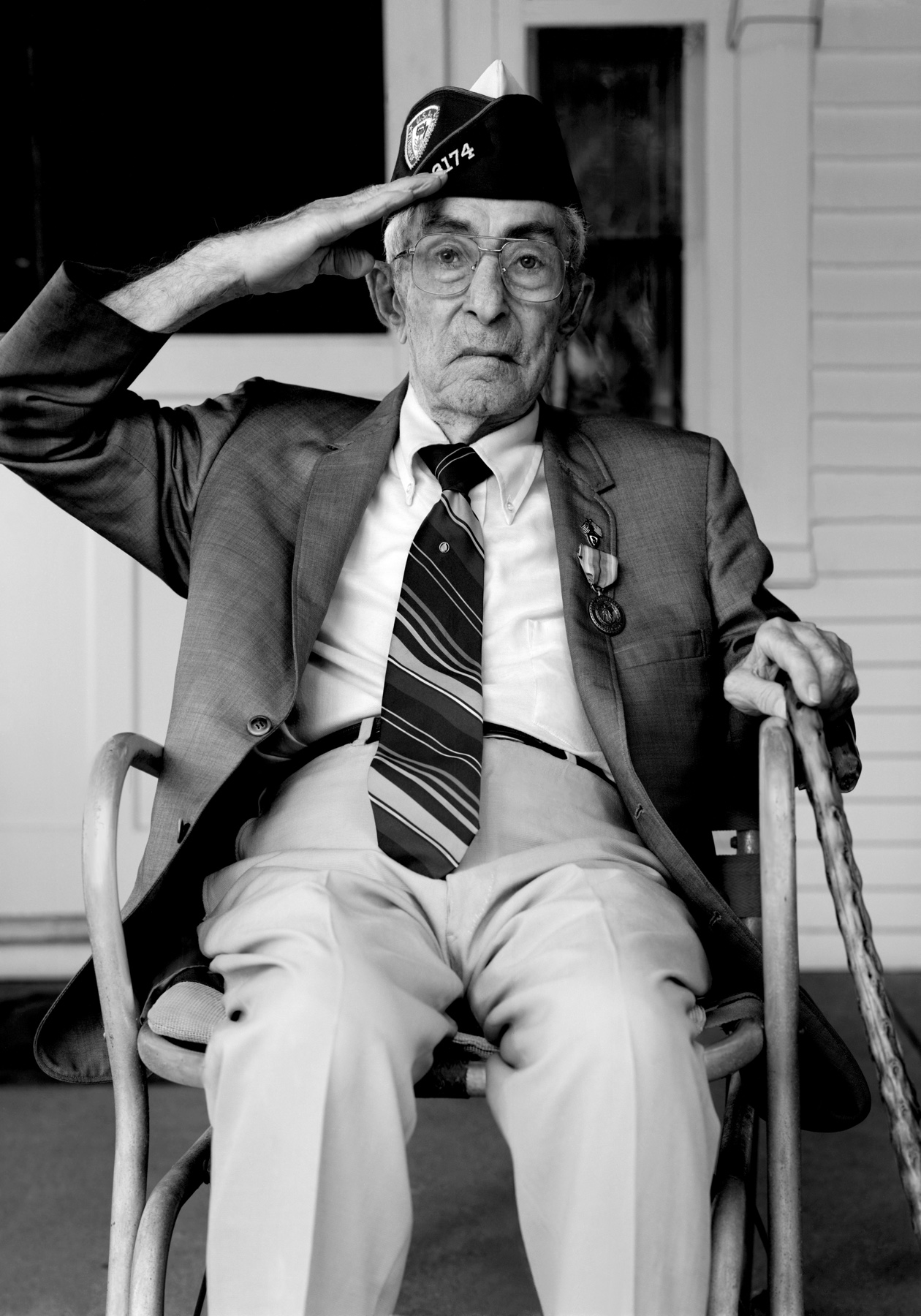
Faces of Five Wars · Original story
Haroutun “Harry” Mullion
U.S. Army · World War I
Read the original story ↓The skin of his face lies like fabric, deeply folded when stretched taut from cheek to chin; and when he speaks, Haroutun “Harry” Mullion’s voice seems much too resonant for such a small body. His sentences are bare as poetry, stripped of extraneous articles so only the main thought hurtles through, the words heavily accented, guttural, as if Mullion were pushing them out with his tongue.
“War, any war, anytime, any place, is awful thing.”
Born on Easter Sunday, 1895, in Palou, Armenia, Mullion has seen too much of war. Through infancy and adolescence, he survived successive Turkish Massacres, arriving in the United States just before the beginning of World War I. Weekly he went downtown to the draft board in Grand Rapids, where, as a native of Turkish-controlled Armenia, he was classified as an enemy alien.
“Why I want to go?” Mullion asks passionately. “Because I was Armenian, and the Turks massacred my people. And this war was going to free the Armenians, that’s why. I had love in my heart for my country.” Mullion pauses mid-gesture, caught by emotion. Impeccably dressed and courtly in demeanor, he hardly seems over a hundred years old. The energy of his spirit is vibrantly young, the memories of his past painfully tender.
Finally allowed to volunteer, Mullion began military service at debarkation hospital in New York. His first job was to meet the ships bringing back the dead and wounded from France. This was the era before body bags or sophisticated field surgery, and Mullion remembers picking up bodies in bushel baskets. His voice breaks still when he recalls the wounded with “no legs, no arms, no eye, no cheek. I felt bad. I try to cheer them up,” he says softly, repeating what he said back then:
“You gonna be all right. We got good doctors and nurses here, good medicine here. They gonna take care of you... But I was sick in stomach saying these things. No arms. No legs. It was awful thing.”
Mullion remembers World War I veterans returning home with no G.I. Bill, no jobs, no homes. He remembers Bonus Marchers, the Shantytown set up by the Doughboys in Washington, D.C., and the subsequent riots, in which some of the soldiers were killed. Others, displaced and desperate, slept on sidewalks or in elevators; some committed suicide, and that too, Mullion sighs deeply, “was awful thing.”
Mullion fared better. Not long after coming home, he went back to his old job at American Seating. The company helped him locate and bring to this country various relatives, his brothers who had been rescued by the Russian Army, his sisters who where living in a Greek orphanage (where he also met his late wife, Mary.) Later, however, when Mullion’s boss, already angry with his union sympathies, discovered Mullion read the pro-Communist Daily Worker, he was fired. Since there was no worker’s compensation or Social Security, Mullion went into business for himself.
What Mullion has loved over the long century of his life hangs on his living room walls: a crucifix, pictures of saints and sacred places, relatives, and Woodrow Wilson, the president who tried, but failed, to return Armenia to the Armenians after The Great War. There is no question now of going back to the old country, but there still belief in what he did for the new.
“If I were young and it happened again,” Mullion says in his improbably deep, strong voice, “I go again. I love this country. I raise my family here, five children. This is the most wonderful country in the world; people don’t appreciate it.”