Faces of Five Wars · Original story
Adelaide Vandenberg
U.S. Navy · World War II and Korean War
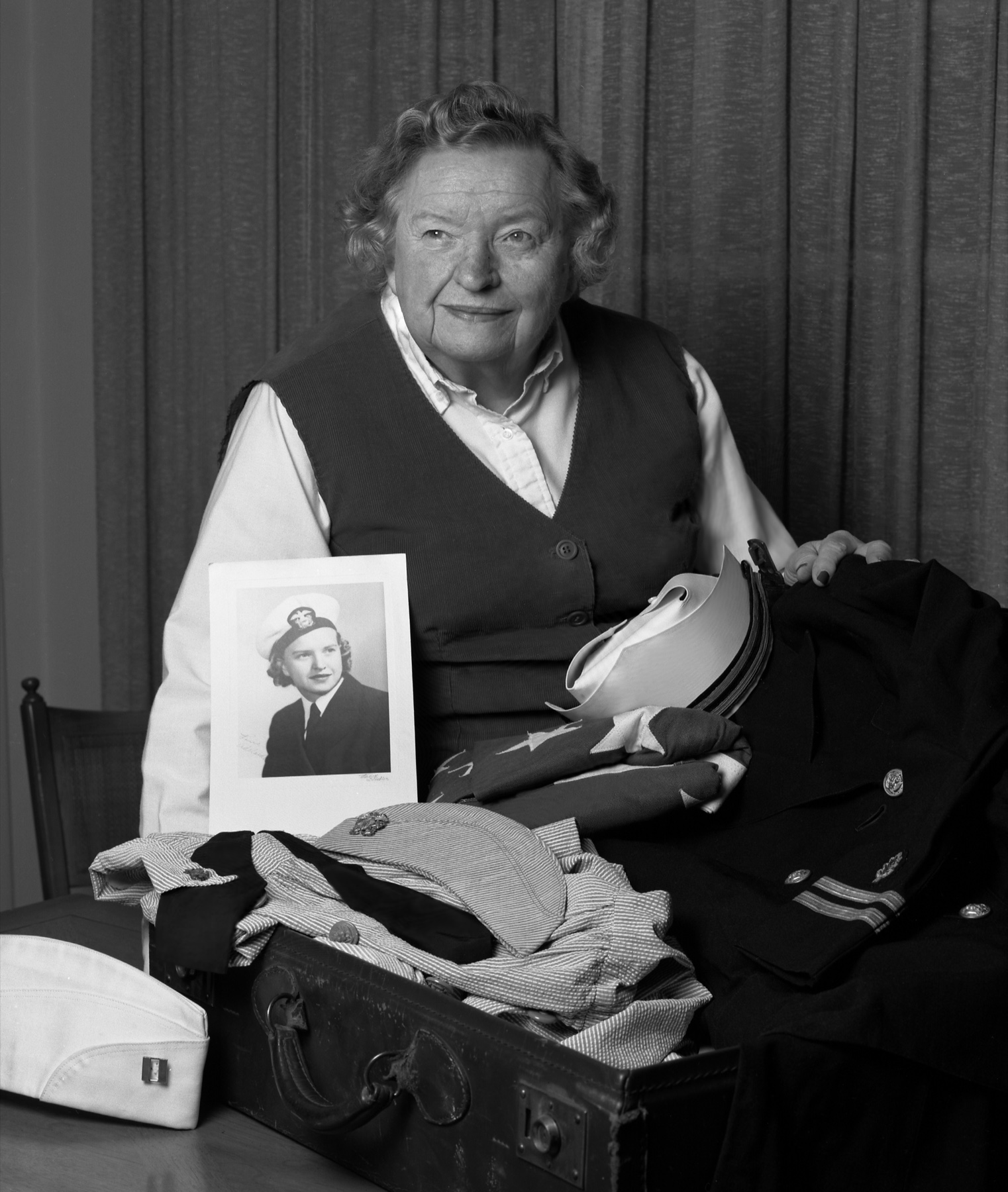
Read the original story ↓On the coffee table of Adelaide Vandenberg’s home in Comstock Park are tiny pieces of porcelain and small, inlaid boxes. Old photographs scattered nearby show her as Adelaide Wilkinson, Ensign, the Lieutenant, Junior Grade, smartly groomed in her summer whites or winter blues. Fondly remembered uniforms spill out of a worn leather suitcase. Altogether, these items tell the story of an irrepressible 21-year-old who graduated from nursing school in Gary, Indiana, and joined the navy.
That was in 1944, just as World War II was beginning to come to its dramatic conclusion. Vandenberg stayed stateside through 1946, working in naval hospitals up and down the East Coast. When the war was over, she found a job in the Burns Clinic at Little Traverse Hospital in Petoskey, Michigan. Because Navy nurses could not resign their commissions for ten years, she was called back to duty in 1950, when the United States joined South Korea’s conflict with the North Korean invaders.
Vandenberg traveled to Tokyo, then by school bus to Yokosuka, a harbor south of Yokohama. A Navy hospital ship became her home for the next six months as she made regular trips to Pusan, South Korea, docking in the harbor and the nursing casualties from the fighting onshore. “There were three (Navy) ships in all,” Adelaide says. They would rotate; “two were always in Korea, and one would be in the harbor at Yokosuka for rest and relaxation and repair.” When in Japan, she went sightseeing once in a car powered by a wood-burning engine. Traveling in Korea was impossible; the entire country was a combat zone. But she does have recollections of an armed guard escort to the beach on May Day, when her superiors feared demonstrations by Communists. “The Navy takes care of its nurses, that’s for sure” she beams.
There are, however, sadder memories, like the cold, December night Marine casualties came in from a Chinese ambush at Changjin Reservoir, near the Manchurian border. On night duty, Vandenberg watched as trucks kept “coming and coming and coming. We had 2200 patients in 48 hours.” There was so little room in the 50-bed hospital that wounded Marines were lined up on stretchers, on both sides of a covered ramp outside, waiting to be evaluated. Vandenberg and the other nurses were moved from their quarters into dependents’ housing, and their rooms were made ready for patients. “At four o’clock in the morning,” she remembers, “I was making bunks up in my old apartment with on of the patients” from the psychiatric ward. “In conversation I said, ‘What are you in for?’” she chuckles, and the man replied, “Oh, I shot a guy.”
A talented photographer, Vandenberg has pictures she took years later of the Korean War memorial in Washington, D.C. A series of large stark figures clad in capes and boots, the Marines seem to rise out of the evergreens that surround them, isolated and alone, as if there were no solid footing beneath them. “The kids,” as Vandenberg refers to her patients, didn’t yet have the kind of protective clothing shown on the memorial statues. That’s why, no matter what other wounds the Marines sustained, they all suffered serious frostbite and some, subsequently, amputations.
Vandenberg’s gaze is somewhere faraway as she sums up the experience: “Everybody took care of everybody.” Patients who had been in the hospital before the attack got out of bed and fetched the wounded “water, bed pans, whatever.” Non-surgical personnel on the base helped too; “the feeling of everybody helping,” she says with a bittersweet smile, “you just can’t describe it.”