David J. DeJonge is a Michigan photographer, entrepreneur, filmmaker, and civic advocate. He founded DeJonge Studio in 1988 and grew it from a basement practice into a portrait studio at the Amway Grand Plaza Hotel. An earlier ninety-second Grand Rapids sitting produced an image used by Newt Gingrich’s organization and led to a documented Washington, D.C., follow-up. In 2008, nine of DeJonge’s portraits of the last surviving World War I veterans entered the Pentagon’s permanent collection. He later directed Pershing’s Last Patriot and founded Legacy Icons, whose cultural-preservation work includes a collaboration supporting Saint Catherine’s Monastery at Mount Sinai.
Press kit · Ready-to-use language
A career built on trust, access, and follow-through.
Ready-to-use biographies, career highlights, interview subjects, and reference links for editors, producers, event organizers, and institutional partners.
One-sentence description
David J. DeJonge is a Michigan photographer and entrepreneur who built two founder-led visual enterprises and applied the same combination of craft, trust, and persistence to filmmaking, public history, policy, and cultural preservation.
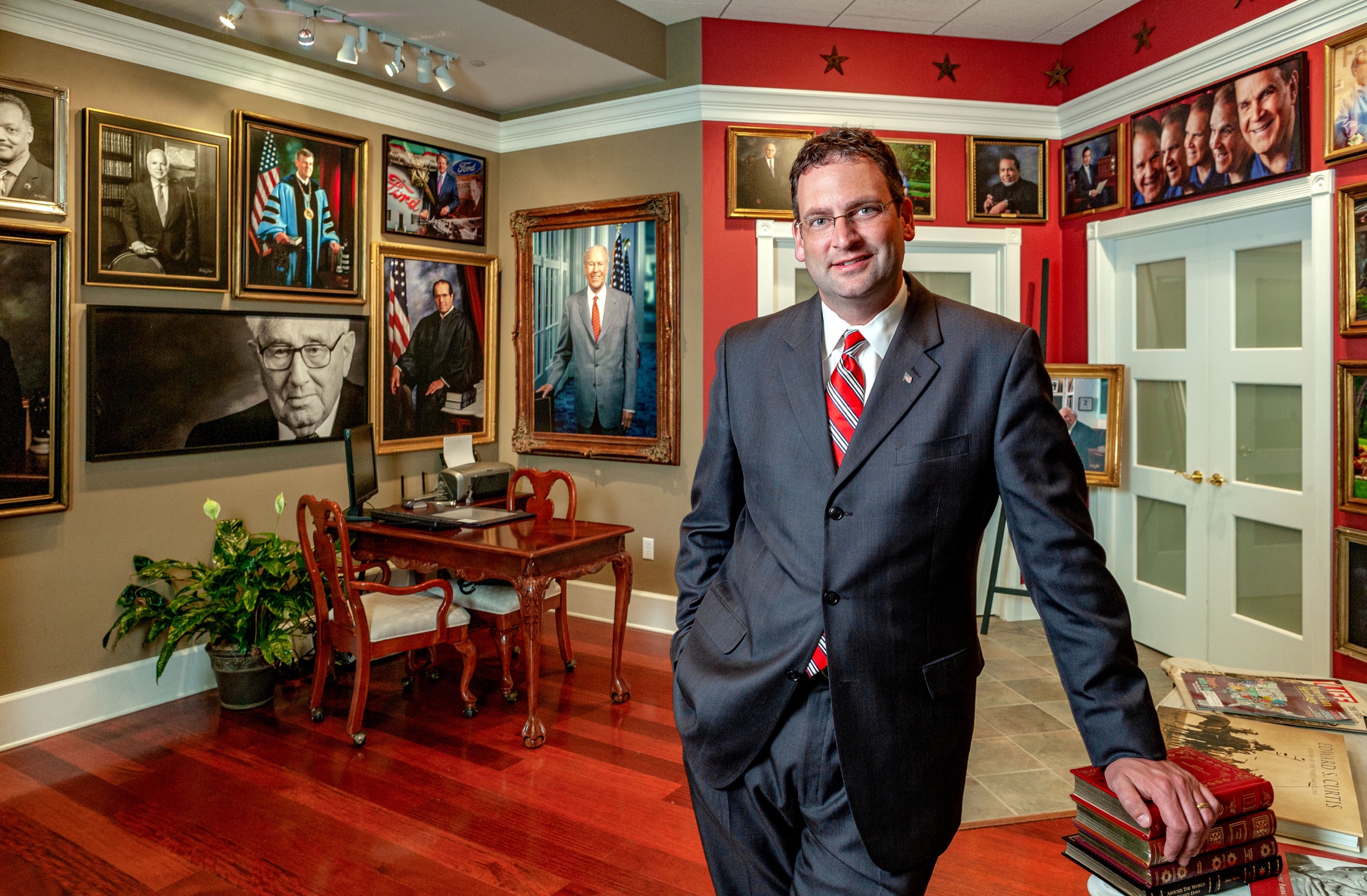
Press portrait
David in the DeJonge Studio.
David J. DeJonge in his studio at the Amway Grand Plaza Hotel in Grand Rapids, Michigan, surrounded by selections from his portrait work. Photograph by Brad Gillette.
A 2400-pixel reference image is available for download. Publication requires permission; contact David for the full-resolution master and caption guidance.
Press-ready biographies
Three lengths, one consistent record.
These versions are prepared for programs, articles, broadcasts, introductions, and institutional materials.
David J. DeJonge is a photographer, filmmaker, entrepreneur, and civic advocate based in Zeeland, Michigan. He established DeJonge Studio in 1988 and built it from a basement practice into a portrait studio at the Amway Grand Plaza Hotel. During an earlier Grand Rapids assignment, he was given ninety seconds to photograph Newt Gingrich; the resulting image was used in Gingrich’s calendar, website, and PAC brochure and led to a Washington, D.C., follow-up documented by Professional Photographer. CNN later presented DeJonge’s 2003 portrait of President Gerald R. Ford as Ford’s last formal portrait around his ninetieth birthday.
In 1996, DeJonge and Grand Rapids Press columnist Karin Orr began Michigan Veterans of Five Wars, interviewing and photographing nearly thirty Michigan combat veterans. The exhibition appeared at the Van Andel Museum Center, the Michigan State Capitol Rotunda, and later as a permanent installation at the Grand Rapids Home for Veterans. In May 2006, he served as campaign strategist, project manager, public-relations point, and lead photographer for ALS Across America. His Route 66 portrait-and-story concept transformed the caravan into a continuing public campaign that Mary Free Bed reports ultimately raised $318,000. Later that year, DeJonge began an independently financed project to find, photograph, and interview the last surviving veterans of World War I. He worked with the Department of Veterans Affairs to identify and document nine veterans whose portraits were unveiled at the Pentagon for permanent exhibition on March 6, 2008.
DeJonge helped organize and served as president of the World War I Memorial Foundation, worked with schools and public officials through a multi-Congress commemoration campaign, published two bylined opinion pieces in The Washington Post, and directed the documentary Pershing’s Last Patriot. He later founded Legacy Icons in 2012, whose cultural-preservation work includes collaboration supporting Saint Catherine’s Monastery at Mount Sinai. As of August 2026, DeJonge reports that the debt-free company has surpassed 90,000 customers and four million annual website visits; founder-provided sales records show annual growth exceeding 40 percent in repeated years.
David J. DeJonge is a Michigan photographer, filmmaker, entrepreneur, and civic advocate whose career has been shaped by a consistent method: get close enough to see clearly, preserve the first-hand evidence, and remain with the work long enough to make it useful.
Raised on twenty acres near Hudsonville, Michigan, DeJonge began his first portrait studio in his parents’ basement. He established DeJonge Studio in 1988 and developed his craft through news photography and private portraiture before operating a studio at the Amway Grand Plaza Hotel. An earlier Grand Rapids assignment became a defining story: DeJonge asked for five minutes to photograph Newt Gingrich and received ninety seconds. The resulting portrait appeared on the Friends of Newt calendar, newt.org, and in a PAC brochure. A subsequent Washington, D.C., session, documented in the March 2000 issue of Professional Photographer, brought Photogenic Lighting marketing director John Shirilla and Eastman Kodak’s Terry Deglau into Gingrich’s office, where DeJonge worked with both 4 × 5 and medium-format cameras. CNN later presented DeJonge’s 2003 portrait of President Gerald R. Ford as Ford’s last formal portrait around his ninetieth birthday.
In 1996, DeJonge and Grand Rapids Press columnist Karin Orr began Michigan Veterans of Five Wars, interviewing and photographing nearly thirty Michigan combat veterans whose service reached from World War I through Desert Storm. The exhibition debuted at the Van Andel Museum Center in 1998, was presented in the Michigan State Capitol Rotunda in 1999, and later became a permanent twenty-four-image installation at the Grand Rapids Home for Veterans.
In May 2006, DeJonge became campaign strategist, project manager, public-relations point, and lead photographer for ALS Across America. He conceived a Route 66 series of environmental portraits at recognizable American landmarks, then edited, wrote, coordinated, and published between stops so each new human story could build attention and fundraising momentum while the caravan moved west. His photographs and a film made with Brett Ellens recorded people living with ALS along the route. Mary Free Bed’s institutional history reports that the campaign ultimately raised $318,000 for people living with ALS in West Michigan.
In 2006, DeJonge turned his attention to the disappearing generation of World War I veterans. Using family resources, he traveled across North America and Europe to photograph, film, and interview surviving witnesses from the United States, Canada, Britain, and Germany. The Department of Veterans Affairs later recorded that DeJonge worked with VA to identify, contact, and document nine veterans. Their portraits were unveiled at the Pentagon on March 6, 2008, and accepted for permanent exhibition.
That day also changed the direction of his public work. Frank Woodruff Buckles, America’s last surviving World War I veteran, attended the Pentagon ceremony and met President George W. Bush at the White House. Later, DeJonge accompanied Buckles to the neglected District of Columbia War Memorial in Washington. DeJonge recalls making two promises there: to help restore the memorial and to continue seeking national recognition for the Americans who served in the Great War.
DeJonge and attorney Edwin Fountain helped organize the World War I Memorial Foundation in 2008, with DeJonge serving as president. The resulting citizen campaign brought together veterans, educators, students, journalists, preservation advocates, and elected officials. DeJonge carried the veterans’ portraits into schools and public venues while working with congressional offices through repeated federal proposals concerning commemoration, a centennial commission, a commemorative coin, and a national memorial. Throughout that work, DeJonge served as a citizen advocate and coalition builder, while Congress and federal agencies carried out their respective constitutional and administrative roles.
The National Park Service completed a major restoration of the D.C. memorial in 2011. Congress subsequently established the World War I Centennial Commission, authorized a commemorative silver-dollar program, and enacted national memorial provisions. The National World War I Memorial opened at Pershing Park in 2021 and reached completion in September 2024 with the installation of A Soldier’s Journey. DeJonge continued to argue for the National Mall location he and Buckles had championed, including bylined opinion pieces in The Washington Post in 2014 and 2018.
He extended the historical project into Pershing’s Last Patriot, a feature documentary for which public credits identify him as director, co-writer, and executive producer. The project also supported civic-education programs in which students researched the war, created exhibitions, raised funds, met Buckles, and joined the national discussion about remembrance.
DeJonge founded Legacy Icons in 2012, bringing his experience in photographic reproduction and historical interpretation to sacred Christian art. That work now includes a collaboration connected with Saint Catherine’s Monastery at Mount Sinai; Friends of Mount Sinai Monastery has publicly documented DeJonge and the Legacy Icons team’s role in developing a replica-icon project that supports the monastery. As of August 2026, DeJonge reports that Legacy Icons remains debt-free and has surpassed 90,000 customers and four million annual website visits. Founder-provided sales records document sustained, compounding expansion, with annual growth exceeding 40 percent in repeated years. The current operating figures are founder-reported rather than independently audited financial statements.
Based in Zeeland, Michigan, DeJonge continues to work at the intersection of trusted access, historical evidence, public purpose, and cultural preservation. His Dutch family-history research forms a quieter part of the same vocation: preserving inherited records for future generations.
Career highlights
Fast facts for editors and producers.
Concise points with direct reference links below.
DeJonge Studio established
Business records document the beginning of the Michigan portrait practice.
Founder-led visual enterprises
DeJonge Studio and Legacy Icons apply exacting visual craft to distinct fields.
Legacy Icons customers
Founded in 2012. Founder-reported 2026 scale also includes more than four million annual website visits and a debt-free position; internal records show annual growth exceeding 40 percent in repeated years.
Amway Grand Plaza studio
The portrait business grew from a basement practice into a studio at the Grand Rapids landmark.
Michigan Veterans of Five Wars
Nearly thirty oral-history portraits led to museum, State Capitol Rotunda, and permanent veterans-home presentations.
ALS Across America
Campaign strategy, project management, public relations, and lead photography turned a Route 66 ride into a public narrative that ultimately raised $318,000.
An image used by Gingrich’s organization
A 2000 trade feature reports that David received ninety seconds for the Grand Rapids sitting; a signed 1999 letter confirms use in a calendar, website, and PAC brochure. A later Washington, D.C., commission produced an updated official portrait.
The Last Witnesses collection
Nine portraits were accepted for Pentagon exhibition in 2008; three additional British portraits made in England continue the international record.
Washington Post records
Five reported or contextual records trace Buckles and the memorial effort; two bylined arguments by David address national commemoration and location.
Cultural preservation
Friends of Mount Sinai Monastery documents the replica-icon collaboration involving David and Legacy Icons.
Two WPPI mastery levels in one year
Within his first year of WPPI competition, David crossed the 25-point APM threshold and the 30-point cumulative AOPA threshold.
Byzanfest Audience Favourite
David’s short documentary Men In Black, featuring Abbot Tryphon, won the festival’s Audience Favourite award.
WPPI competition honors
Michigan Retailer reported eight convention honors, including six Awards of Excellence and first place in Journalism.
Hubble Medal of Initiative
The Hubble Legacy Committee recognized David’s World War I photography and memorial advocacy.
Distinguished Alumni Hall of Fame
Hudsonville recognized David for Cultural and Performing Arts Accomplishments.
U.S. Army record ↗
Department of Veterans Affairs ↗
IMDb film credits ↗
Friends of Mount Sinai ↗
Byzanfest 2015 winners ↗
Professional Photographer · March 2000 · pp. 28–32 ↗
Michigan Retailer · May 2003 ↗
Hubble Medal roster ↗
Hudsonville induction profile ↗
PPA AN-NE Award · 2006 ↗
ALS Across America · Congressional Record ↗
ALS Across America · Mary Free Bed ↗
Complete press and public record →
Interview topics
First-hand history with contemporary consequences.
David speaks from direct experience and documented work on the following subjects.
The ninety-second Newt Gingrich portrait—and what trusted access requires
Finding and documenting the last World War I veterans
Frank Buckles and the obligation to “keep your word”
How a citizen campaign navigates Congress
Students as participants in public history
Print permanence, faithful reproduction, and the methods later carried into sacred art
Building a portrait studio from a Michigan basement to the Amway Grand Plaza Hotel
Translating photographic craft into Legacy Icons and cultural preservation
Name & attribution
Consistent identification.
For professional coverage, use David J. DeJonge on first reference and DeJonge thereafter. For family-history contexts, use David Jon DeJonge. Historical Dutch ancestors retain the spelling shown in their records, most often de Jonge.
David’s personal studio mark is the original black-aperture, red-star, and gray-star logo used during his photography career. It is his contemporary professional identity.
Preferred professional description: photographer, filmmaker, entrepreneur, and civic advocate. For the World War I work, citizen advocate, foundation president, documentarian, and public-history organizer accurately describe distinct parts of the record.