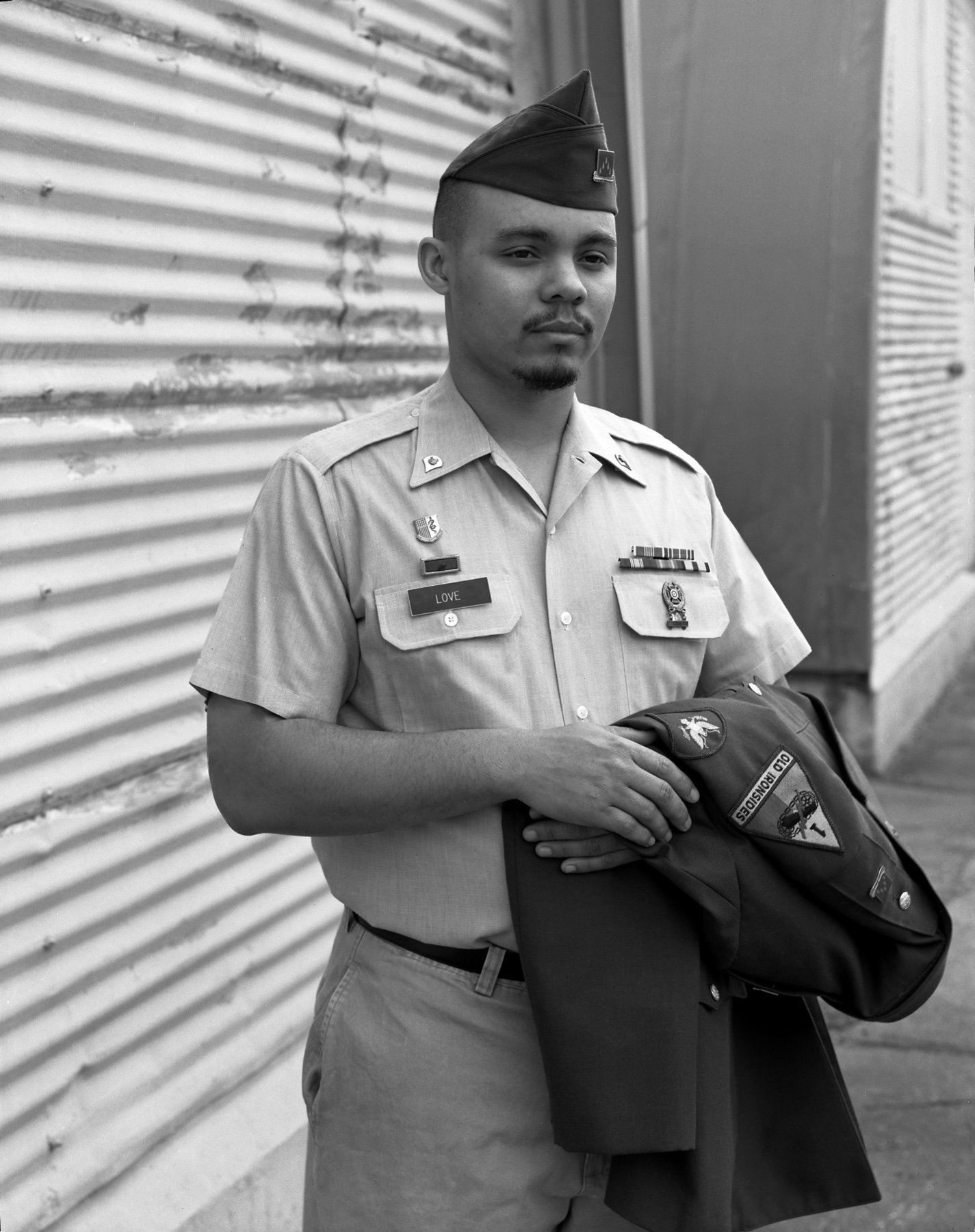
During Desert Storm the ground war may have lasted only 100 hours; but for Mark Love of Grand Rapids, those were “the longest days of my life.” A medic, Love had already been stationed in Germany for two and one-half years before the Gulf War began. “I remember when it all first started, and I thought, ‘Man—I hope we don’t go over there’,” Love says.
But once in the Gulf, “I wanted to be a part of it,” Love reveals. “I didn’t want to be a medic; I wanted to be an active participant.” A picture taken at the time shows Love in front of a tank in a relaxed yet ready stance, a self-assured smile on his handsome young face. Actual battle, as Love would soon discover, wasn’t so much fun.
“You go through all this training, but once you get there it’s totally different,” Love remarks. “We trained in trees and hills. But out there it was totally flat,” and there were few landmarks for figuring locations. On February 23, 1991, the first night of the ground war, they had been driving in complete darkness for hours, then Love saw a flash of light. “I thought… it’s starting right now,” he exclaims. But it was a tank firing “at one of our own helicopters that had landed out there with mechanical problems. Fortunately we missed.”
By the next morning, “it was just chaos,” and all the next night, their 2300-pound vehicle rocked back and forth with the impact of all the bombs. Thinking about the son he had never seen, who had been born the day before, and wondering if he would ever see his family again, Love “cried like a baby.”
By day Love waited in his personnel carrier, a little portable ambulance, one-quarter to one-half a mile in back of the troops. “I can remember just praying, ‘Ple-e-ase’,” Love says, holding the vowel with intensity. “Don’t let anything happen to any of these guys.” He had never dealt with so much as a gunshot wound; and though he believed he would have done whatever was needed, Love feared he was not ready. And these were his friends.
Love did not expect to be treating Iraqi wounded, either. But they came “in droves, with their hands up…all injured.” His feelings of compassion were never diminished when he helped the enemy. But Love was shocked that “they were so happy to give up and see us. They finally got a chance to eat; they finally got fresh water.” The poor condition of the Iraqis made Love angry. “I don’t see how Saddam could put his people through that,” he says, referring to the Republican Guard’s being “up against the best military in the world,” under-armed, lacking medical supplies and food. “And they were supposed to be his best troops.” Some “looked 16 or 17,” Love reports, “and some looked 40 or 50, but they didn’t look like soldiers.”
Of all his war memories, riding down the “Road of Death” is Love’s worst. There was only one highway the enemy was able to use when they fled Kuwait for Iraq, and it was littered with blasted vehicles and the bodies of those trapped and burned inside. “You know, you could still see,” Love stammers; “you could still see the expressions on their faces.” At one point, Love and his buddies discovered a couple of shallow graves, “partially dug up because there were wild dogs out there.” Body parts were “just laying on the ground.”
Kicking sand over the corpses, trying to cover them back up, Love remembers, “That’s when it really hit me: These are sons and husbands out here, getting killed.” Now Love is grateful he never had to “pull and trigger and take a life.” When he first got back home and people asked, “‘Did you shoot anybody?’ or ‘blow up anything?’ I’d tell them no,” Love says, his soft eyes sad and knowing, “and I’m glad I didn’t.”