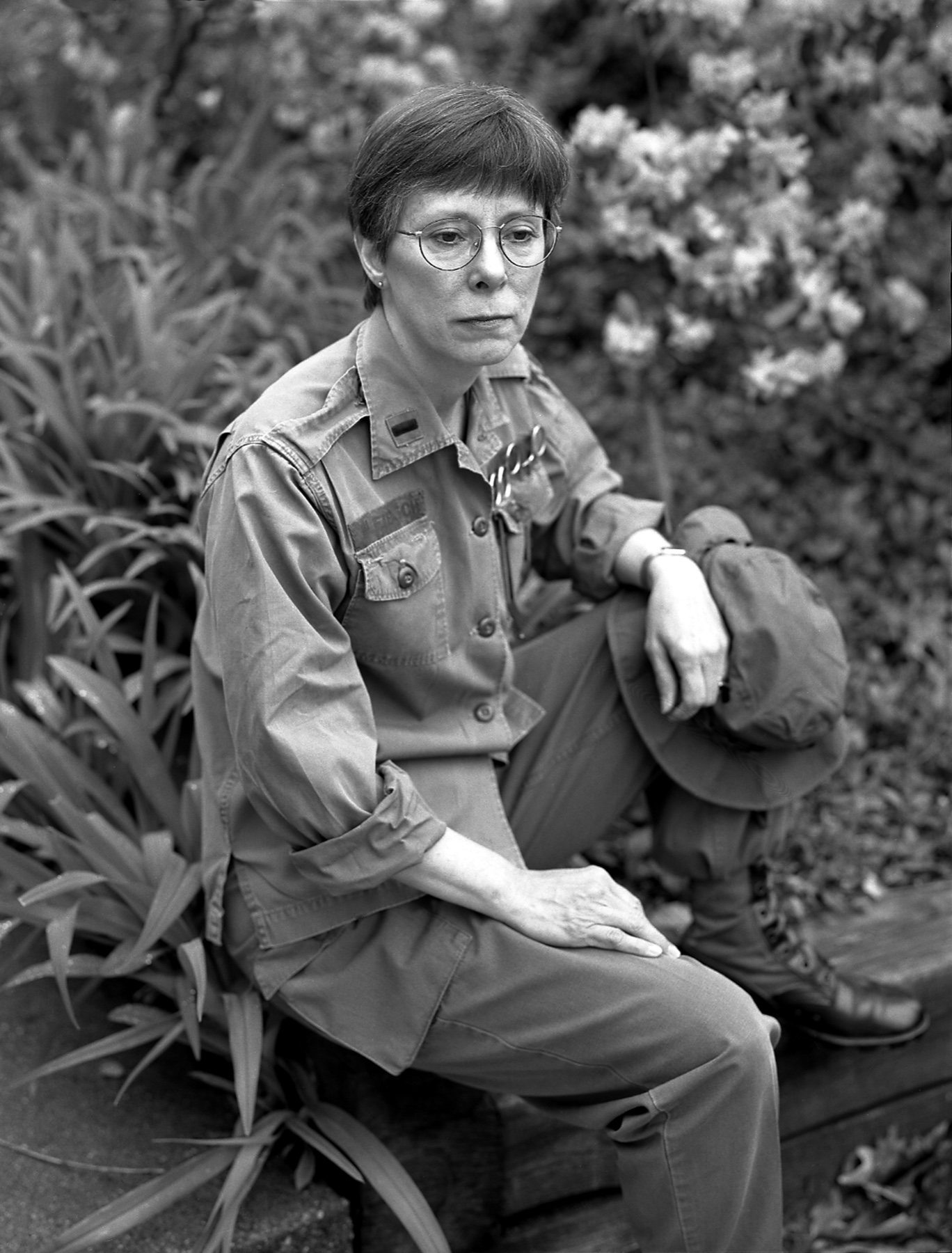
Faces of Five Wars · Original story
Marcia Van Ess
U.S. Army Nurse Corps · Vietnam War
Read the original story ↓When Marcia Van Ess came home from Vietnam, she never thought of herself as a veteran. To her, “veterans were grandpas, uncles, and old people.” Van Ess never really felt like “regular Army,” either. She had joined the service to help finance her education in nursing school at St. Mary’s Hospital in Grand Rapids. Two years active duty was the repayment. Eventually a 1st lieutenant, Van Ess still thought “drilling was silly.” She often crossed the street to avoid saluting superiors, and sometimes didn’t blouse her pants over her boots correctly.
“I guess I had a bad attitude,” Van Ess smiles. Once in Vietnam, however, she immersed herself in the work of the 24th Evacuation Hospital at Long Binh. From October of 1970 to November 1971, she cared for the “pre-op” patients awaiting surgery and the recovery patients coming out of it. She also had the care of those considered hopeless. There weren’t many of these patients, and most of them were so severely injured or brain-damaged they could not have survived anywhere. Yet Van Ess is haunted by the knowledge that, “we didn’t have the greatest equipment, and sometimes I think we could have saved more if we had a better hospital.”
At the time, Van Ess pushed these feelings away so she could function. She cared for South Vietnamese casualties and civilians, even North Vietnamese prisoners, although she found helping them difficult, especially when the helicopters would bring in the American wounded, then “right behind them would be the guys that did it.” Always there was the threat of attack, the sound of gunfire somewhere outside, the danger of an enemy within. It was impossible to tell a South Vietnamese ally from a Vietnam Cong Communist sympathizer.
As the war’s action slowed and the political focus blurred, many of the American casualties had too little to do and too many available drugs. “It became so bad,” Van Ess reports, “that part of the hospital was turned into drug rehab; you couldn’t leave the country without a urine test.” Never “into the right or wrong” of the war, Van Ess was increasingly disillusioned. She questioned why “they weren’t accomplishing anything,” yet the patients, once healthy 18- or 19-year-olds, kept coming in, horribly mangled from mines and booby traps. “It started to feel useless.”
When her tour of duty was over, Van Ess returned to Grand Rapids and got on with her life. She thought about Vietnam rarely, when the sound of helicopters would “send shivers” up her back, and once when she had to step out of a nail parlor where two women in a back room were speaking Vietnamese. It was not until Van Ess saw a story about the memorial being built to honor the women Vietnam veterans that she began to examine what the whole experience had meant.
The article was in a nursing magazine, and Van Ess thought: “That’s me. I was part of that.” Soon after she contacted the Vietnam Veterans chapter in Holland and ended up marching in the Tulip Parade. The crowd’s reaction—and her own response—was something Van Ess never expected. Riding on the Veterans’ float she saw people take off their hats or stand and salute. She heard them yell “Thanks!” and “It’s about time we saw a woman!” At the end of the parade, she was in tears. “I didn’t know how much I needed that,” she says, full of wonder.
In the years since, Van Ess has attended veterans’ reunions, “always searching for that one face, somebody I may have taken care of.” She volunteers at the Michigan Museum of Military History in Holland and has accompanied infantry vets when they give presentations in school. Hearing their experiences, and having them give credit to hers, has brought Van Ess gifts she never expected: understanding, a sense of belonging, the vocabulary of a shared experience that touches the soul. As Van Ess puts it in her own words: There’s still “some kind of a bond, even after 20-something years… with just a look, they understand what I mean. I don’t have to explain anything.”