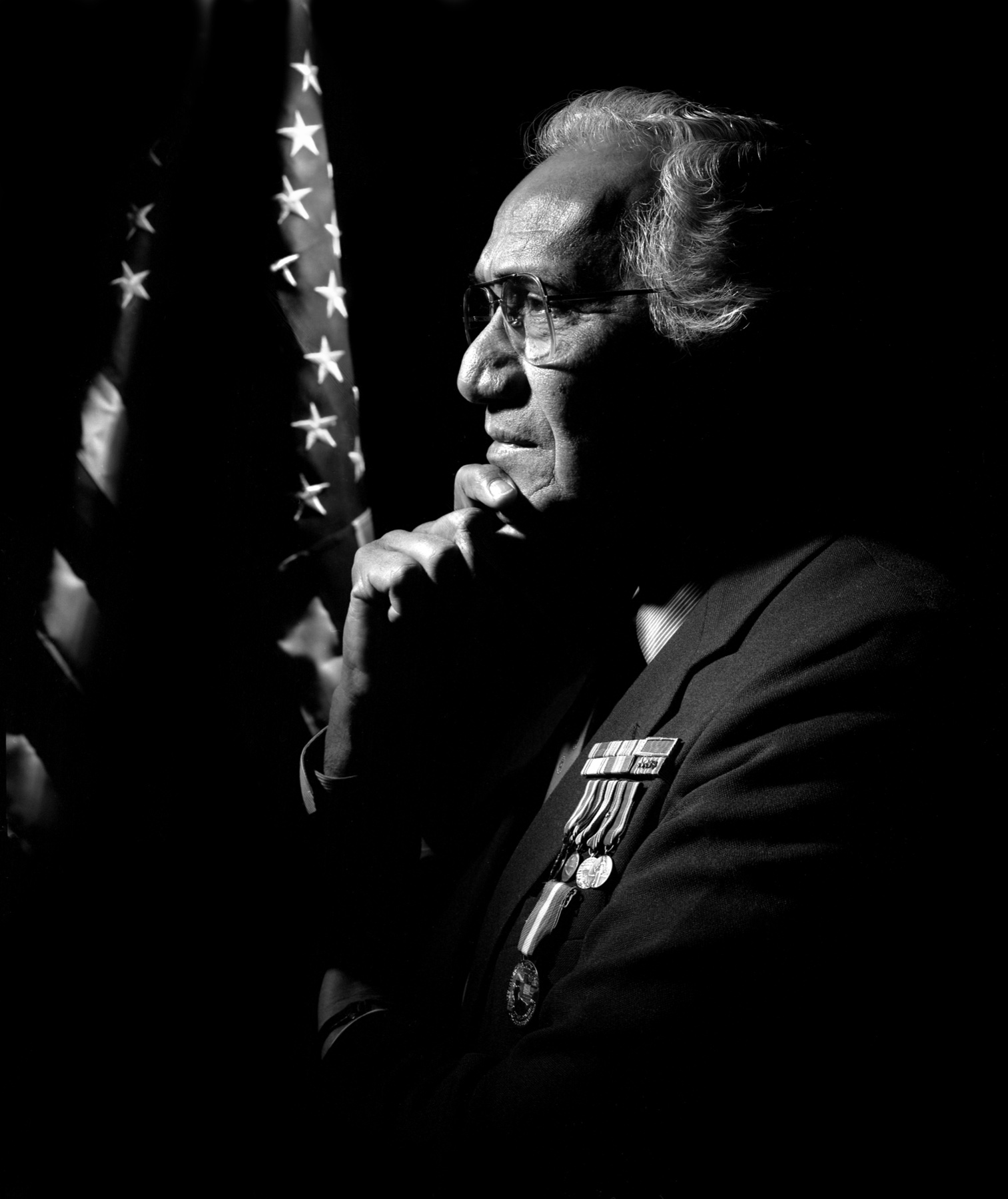
Faces of Five Wars · Original story
Francisco M. Vega
U.S. Army Air Corps, Air Force and Signal Corps
Read the original story ↓When Japanese forces hit Pearl Harbor, Francisco Vega got a call from an uncle Valentin Lopez Tapia, from Mexico. Speaking proudly of the family’s military tradition, the uncle said: “If your country’s being attacked, don’t wait to be called; volunteer your services.”
Immediately the next day, Vega tried to enlist in the Army, then the Air Corps and Navy. “They all told me they weren’t taking Mexicans at this time,” Vega remembers. “I couldn’t tell my family.” Finally able to volunteer, Vega, a Texas State Championship typist, was eventually assigned to Eisenhower’s Headquarters as a Teletype operator. In fourteen months, he progressed from private to the battalion’s personnel sergeant major.
“We really were not worried about rank,” Vega says. “All the time I was there it was combat . . . There were five campaigns, and I was in every one of them.” For a month he worked four-hour shifts and never took off his clothes, not even his socks.
Vividly Vega recalls the confusion of landing on Omaha Beach. Each man carried awkwardly heavy loads, and some got their ankles caught and legs broken in the nets used to lower them over the sides of the boats. Others were smashed between the wave-rocked boats and the landing gear.
“We came off the landing barges, and guys came out of the channel in wet suits and connected the cable. We started typing right back to England,” Vega reports. “All of the sudden, I heard the expression, ‘Ese, guy,’ Spanish for, ‘Hey man.’ Just as I turned around to see who said that, a bullet pierced his helmet, and that was it.”
During the nightmarish St. Lo Breakthrough, Vega typed out two messages about eight feet long, primarily in code. Then the P-38’s came in, plane after plane, saturating the area (and some American troops) with concussion bombs. “We were at a distance,” Vega says, “but the ground started shaking; we could feel it, and pretty soon this cloud of dirt and dust went up; then it started to rain.”
Other memories come back too: driving, alone in the dark, with no lights, through the Ardennes Forest during the Battle of the Bulge; seeing “people standing by the sides of roads” near “bombed-out towns,” in one the mayor in tuxedo and top hat, waiting to surrender, waving him through; witnessing, somewhere in Germany, emaciated prisoners, “just standing there,” watching two well-fed guards that the prisoners had gutted slowly die.
When he talks about these times, Vega shifts uncomfortably in his chair and clears his throat. For the Fiftieth Anniversary of the Normandy Invasion, he received the Medal of the Region, from the Republic of France, President Rene’ Garrec and the Regional Council of Lower Normandy, and his name was read aloud on Omaha Beach. But he was not there. Even now he cannot read the letter that accompanied his decoration without much emotion.
“You always wonder what the future was,” he says, trying to articulate the horror and wast of war. “What was the potential? . . . We’re talking (young men) nineteen or twenty years old . . . when I read that letter, I thought—this is not a news release. Those crosses are there.”
Vega believes strongly in democracy and the family. “They are not,” he is fond of saying, “spectator sports.” And he knows it helps to trust “that there’s something else besides yourself, whatever you’re going to call it . . . because it doesn’t make it worthwhile to do anything unless you have a hope, a belief in something.”